

 Stephen Walters
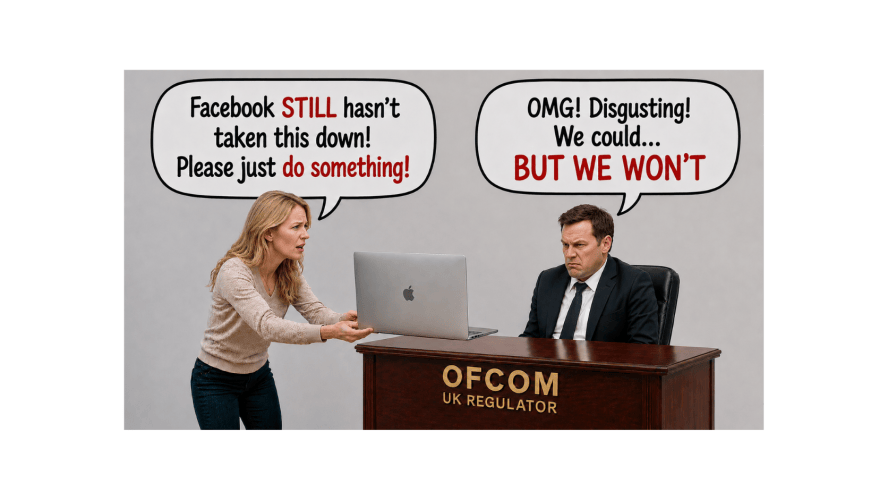
From now onwards, when fake ads steal your savings or deepfakes steal your face, YES you can legally tell Facebook and YouTube THAT they must be taken down, but not WHEN
Legal issues are covered in more detail further down this page
So you see a Facebook ad using a famous person’s face to sell some bogus investment. Maybe it looks just convincing enough to empty someone’s bank account.
Or someone creates some disgusting video using your face.
You report it. You expect Facebook to take it down. Surely these new online safety laws that politicians have finally brought in mean that somebody now has to do something?
Well, yeah but don’t start holding your breath.
Two fakes, one frighteningly familiar problem
Scam adverts and deepfakes have become two of social media’s most recognisable dangers.
The two can also be combined. Fraudsters can use artificial intelligence to make celebrities, financial experts or trusted public figures (or even you, or someone you know) appear to recommend investments they (or you) have never heard of.
The Bank of England warned on 9 June 2026 about AI-generated scams after deepfake videos appeared showing Nigel Farage fighting its governor, Andrew Bailey.
Bailey urged people to report the videos. He also warned that fake adverts impersonating banks and other trusted organisations were being used to exploit the public.
But reporting something and getting it removed aren’t anywhere near being the same thing.
Facebook will have to investigate scam adverts
On 10 July 2026, Ofcom published proposed rules for fraudulent advertising.
The proposals cover paid-for scam adverts on Facebook, Instagram, TikTok, X, YouTube and other major online services.
Facebook would have to provide an easy way for people to report suspected fraudulent adverts. You should be able to explain why you think an advert is fraudulent and provide supporting evidence.
Unless Facebook decides that your complaint is obviously unfounded, it should treat your report as a reason to suspect the advert may be fraudulent.
Facebook would then examine the advert. If it decided that it was fraudulent, it should remove it and ban the advertiser from advertising to UK users.
That sounds like exactly what people have been demanding.
Then come the gaps.
How long does Facebook get?
Ofcom says Facebook should “swiftly” remove an advert once it has identified it as fraudulent.
But Ofcom’s detailed proposals also say it isn’t planning to provide detailed guidance on how quickly Facebook should act.
Facebook would be expected to remove a fraudulent advert as quickly as it considers possible for that advert and its service.
So what does “swiftly” mean when an advert could be stealing people’s life savings?
Ten minutes? Ten hours? Ten days?
Ofcom doesn’t say.
ReplyResearch could also find no proposed requirement for Facebook to acknowledge an ordinary person’s scam-ad complaint, give them a reply date or tell them what it finally decided.
Your complaint must enter Facebook’s checking system. An answer doesn’t necessarily have to come back out.
What about deepfakes?
Not every deepfake is automatically illegal. A comic impersonation or an obviously altered political video won’t necessarily have to be removed simply because it isn’t real.
But deepfakes can also be used for fraud, harassment and sexual abuse.
A paid-for deepfake designed to con people could be covered by the proposed fraudulent-advertising rules.
A fake sexual image made and shared without consent may be illegal intimate-image abuse. Ofcom has also been strengthening the rules covering social media’s handling of illegal sexual images.
On 25 June 2026, Ofcom announced stronger protections. These include easier reporting, properly trained staff and systems designed to take illegal material down “swiftly”.
There’s that word again.
For someone whose fake sexual image is being copied, shared and downloaded, every hour matters. Yet “swiftly” still doesn’t provide a clear maximum waiting time.
Facebook decides, and Facebook keeps the clock
Ofcom is separately consulting on wider social-media complaint rules.
These could cover Facebook failing to apply its own rules properly, wrongly removing posts, mishandling accounts or failing to provide promised safety controls.
The proposals say complaint routes should be easy to find and use. Facebook should acknowledge complaints, provide an indication of how long an answer may take and explain its eventual decision.
But Ofcom has deliberately refused to set an outside deadline.
It says complaints should be handled within timeframes Facebook itself has determined are appropriate.
Facebook would therefore decide how to handle your complaint, whether its rules were broken and how long it should be allowed to answer you.
Advertisers get a better promise
There’s an extraordinary contrast inside the fraudulent-advertising proposals.
If Facebook removes an advert and the advertiser appeals, Ofcom says that appeal should be decided “promptly”.
That protects legitimate businesses from having genuine adverts wrongly removed.
But the ordinary person reporting an advert that could steal someone’s savings isn’t expressly promised the same prompt decision.
The advertiser trying to get an advert put back receives a clearer promise than the person trying to protect others from being conned by it.
Ofcom won’t take up your case
If Facebook fails to deal with your complaint, you can report the problem to Ofcom.
But Ofcom’s public complaints guidance contains an important warning:
“We cannot respond to or investigate individual complaints.”
Ofcom can use complaints as evidence that Facebook may be failing more widely. It can investigate the company and potentially impose enormous fines.
What it won’t do is investigate your individual fake advert, order your particular deepfake to be removed or make Facebook give you a proper answer.
There’s no social-media ombudsman to decide your case. There’s no fixed waiting period after which you can take it to an independent complaints body.
The company you’re complaining about remains in charge of the complaint.
Wasn’t this what the law was supposed to fix?
Ofcom says fraudulent adverts cost UK victims about £200 million each year.
Public anger over sexual deepfakes has also exploded as artificial intelligence has made convincing fake images easier to create and distribute.
These aren’t obscure technical problems. They’re exactly the kind of highly publicised outrages that created the demand for tougher regulation.
The proposed rules could force Facebook and other social media companies to improve how they find and remove fakes. That matters.
But the person reporting the fake could still be left watching and waiting.
A scam advert can keep finding new victims. A sexual deepfake can keep being shared. Facebook can decide how quickly it acts, while Ofcom refuses to decide your individual case.
So yes, the law may eventually make Facebook take down fakes.
Just don’t expect it to tell you exactly when.

Sources and relevant reading for “Ofcom on taking down that Facebook fake: no we won’t help you”
Sources mentioned in the article
- The Guardian , Bank of England warns of AI scams as deepfakes of Farage-Bailey fight spread , 9 June 2026. Reports the deepfake videos showing Nigel Farage apparently fighting Bank of England governor Andrew Bailey and the warning that they were being used to promote investment scams.
- Ofcom , Consultation: Fraudulent Advertising Codes of Practice , 10 July 2026. The principal consultation setting out Ofcom’s proposed rules for paid-for fraudulent advertising on major social-media and search services.
- Ofcom , Summary of reports, complaints and appeals , 10 July 2026. Explains how an ordinary user’s scam-ad complaint would enter a platform’s moderation system, while an advertiser appealing against removal should receive a decision “promptly”.
- Ofcom , Volume 4: Terms of service and complaints , 10 July 2026. Contains the wider proposed complaint rules, including acknowledgements, indicative response times and outcome notifications. It also confirms that Ofcom hasn’t specified an outside deadline and would let providers determine what timeframes are appropriate.
- Ofcom , Tech firms must do more to block unwanted sexual images, under strengthened Ofcom protections , 25 June 2026. Sets out the strengthened reporting, staffing and moderation measures for illegal sexual images, using the requirement that systems be designed to remove the material “swiftly”.
- Ofcom , An online advert , 30 October 2023. Ofcom’s current public complaints guidance tells people to report scam adverts to the service first, but expressly states that Ofcom cannot respond to or investigate individual complaints.
- Ofcom , Big Tech must tackle scourge of scam adverts, says Ofcom , 10 July 2026. Summarises the proposed anti-fraud measures and provides Ofcom’s estimate that victims lose more than £200 million annually to fraudulent online adverts.
Relevant reading
- Ofcom , Online safety super-complaints , 2 January 2026; updated 10 February 2026. Explains the escalation route available to eligible organisations while confirming that individuals cannot use it and that Ofcom cannot investigate their cases or order particular content to be removed.
- Ofcom , Detecting intimate image abuse , 18 May 2026. Describes Ofcom’s hash-matching measures for limiting the spread of non-consensual intimate images and discusses the growing contribution made by generative AI.
- UK Government , Tech firms will have to take down abusive images within 48 hours under new law , 19 February 2026. Provides important additional context: separate legislation introduced a 48-hour maximum for removing reported non-consensual intimate images, including protection connected with sexual deepfakes.
- Which? , Social media deepfakes promote sham Quantum AI investment scheme , 12 March 2026. Documents celebrity deepfake adverts found on Facebook and Instagram, explains how the investment scam operates and examines the delay before platforms face the fraudulent-advertising duties.
- Help Net Security , Fake scandal clips on Facebook bait victims into investment scams , 16 March 2026. Reports research identifying hundreds of Facebook advertising campaigns that used fake news reports, public-figure impersonation and fabricated confrontations to draw victims into fraudulent investments.
- The Guardian , Investment fraud in UK soared to more than £220m lost last year, trade body says , 15 June 2026. Shows the financial scale of the problem, reporting that investment-scam losses rose to £221.5 million as AI made fraudulent websites, messages, voices and impersonations easier to produce.

Footnote Zone for “Ofcom on taking down that Facebook fake: no we won’t help you”
Disclosure: The diagnostic tools referenced below were developed by NokNok, a specialist in online responsiveness tool design.
This Footnote Zone uses NokNok’s four-part diagnostic toolkit to examine whether social-media reporting systems provide a findable route, a timely response, a meaningful decision and a workable escalation path when users report scam adverts or harmful deepfakes.
- Email Finder: The proposed rules say reporting and complaint routes should be easy to find and use, yet the article shows how a user remains dependent on contact routes controlled by the same social-media service that decides the complaint. Email Finder scans an organisation’s website and related public-facing materials for published email addresses, then reports missing routes, discrepancies, structural deficiencies and other contactability gaps that can leave users trapped in a single reporting channel.
- Reply Radar: For scam-ad reports, the proposals contain no express requirement for an acknowledgement, reply date or final decision; for wider complaints, services can set their own timeframes. Reply Radar deploys targeted test emails and quantitatively measures reply rates, latency, response consistency and related responsiveness benchmarks, revealing whether a reporting route produces a timely answer in practice.
- Compliance Sniffer: The article identifies a second gap between receiving a message and giving a useful answer: an advert report can enter a checking system without any substantive decision coming back, while wider complaint rules require explanations but set no outside deadline. Compliance Sniffer analyses incoming responses against objective benchmarks for quality, clarity, relevance, escalation and compliance, distinguishing a meaningful outcome from a generic acknowledgement, empty platitude or evasive reply.
- Mystery Shopper: A user may report a fake to Facebook, wait on Facebook’s self-set clock, notify Ofcom and still find that Ofcom won’t investigate the individual case and no ombudsman can decide it. Mystery Shopper executes a comprehensive end-to-end responsiveness UX audit, testing a real user’s contact, response and escalation pathways to identify the point at which reporting, removal or independent redress breaks down.
Disclosure: The diagnostic tools referenced in this Footnote Zone were developed by NokNok, a specialist in online responsiveness tool design. ReplyResearch may use NokNok tools, resources, or analysis when preparing coverage, while retaining responsibility for its editorial decisions, including what topics to cover, what sources to cite, and how stories are presented. Read the full ReplyResearch Collaborative Disclosure Policy.


