


 Peter Friedman
Britain’s rail regulator says that 97.2% of complaints were dealt with within 20 working days in 2025-26. That sounds impressive. But when passengers are asked what they thought, the story becomes much less comfortable
The number that looks like success
The Office of Rail and Road says that train companies dealt with 336,332 complaints in 2025-26, four per cent more than the year before. Of these, 97.2% were “closed” within 20 working days.
“Closed” is the regulator’s word. It means that the company had finished dealing with the complaint before the deadline. It doesn’t necessarily mean that the passenger thought the complaint was sorted.
The regulator also says that 73% were dealt with within ten working days, comfortably inside the 20-day limit. Only a small share of complaints went beyond the deadline.
But that still leaves the question that passengers care about: was the answer any good? To find that out, the regulator also asks the people who actually made the complaints what they thought.
Passengers tell a very different story
The regulator’s 2024-25 satisfaction figures cover the previous year, not the same year as the new 2025-26 timing figures. We can’t directly compare them, but they show how different the two questions are.
Only 31% of passengers surveyed were satisfied with how their train company dealt with their complaint. Only 29% were satisfied with the result, while 28% thought that the company had fully dealt with their complaint.
Just 27% thought that the train company had seemed keen to reach a solution that they could accept. So a complaint can be dealt with even when the passenger feels that little was achieved.
The 97.2% figure isn’t wrong. It tells us how often companies met the time limit. It doesn’t tell us whether passengers thought that the answer was useful, fair or actually sorted anything out.
A reply is not the same as sorting it out
When a complaint arrives, the clock starts. Somebody replies. The company marks the complaint as finished, and the clock stops. Those events are easy for the company to record and turn into a percentage.
The passenger wants to know something else. Did the reply answer the question? Did it put anything right? Did somebody take responsibility, or did the passenger have to send another email or make another call?
A fast but irrelevant answer still meets a deadline. A polite explanation that changes nothing still counts as a reply. And somebody who gives up may never contact the company again.
That’s the gap at the heart of this story. Train companies can become very good at proving that they replied on time while knowing much less about whether those replies actually helped passengers.
The railway can count what it did
This is a recurring problem in organisational responsiveness – in plain English, how well organisations answer and act when people contact them. Organisations can most easily count their own actions.
Managers can see when a complaint arrived, when somebody replied and when the company marked it finished. They can measure those things precisely because every step happens inside systems that they control.
The passenger sees the other half. They know whether the reply helped, whether anything changed and whether they had to contact the company again. Those things are much harder for the company to count.
That’s why a very high figure for meeting the deadline should lead to another question, not a victory lap: what did passengers think after the reply arrived?
What you count changes what people do
There’s nothing wrong with measuring reply times. Nobody wants complaints left unanswered for months, and a clear deadline gives train companies a strong reason to get back to people promptly.
The trouble starts when hitting the number becomes more important than dealing properly with the complaint. Reward people for marking complaints finished, and that’s what they get good at.
The same thing happens elsewhere. Managers can praise a chatbot because fewer customers reach a human adviser. They can praise a call centre because each call takes less time.
Those numbers may show real improvements. But if customers have to repeat themselves, try another way of getting help or quietly give up, the organisation can improve the number while missing the point.
Ask what happened after the reply
The Office of Rail and Road deserves credit for looking at both sides. It records how quickly train companies deal with complaints, but it also asks passengers what they thought afterwards.
More organisations should do that. The useful question isn’t simply whether somebody replied. It’s whether the answer helped enough that the person didn’t have to keep chasing for a useful response.
Then comes the harder question: what happened next? Did the passenger write again, take the complaint to somebody else, accept an answer they disliked, or simply decide that carrying on was pointless?
Those answers are harder to turn into a neat percentage. But they tell us much more about whether people were actually helped, rather than simply sent something before a deadline.
97% is where the questions should start
Britain’s train companies can say that they finish dealing with almost every complaint within the regulator’s 20-working-day deadline. That matters, and it is far better than simply leaving people unanswered.
But “we replied on time” and “the passenger thought we dealt with it properly” are different claims. A company can be excellent at the first and still disappoint badly on the second.
So 97% shouldn’t end the discussion. It should prompt the next question: after the railway replied, how many passengers could honestly say, “Yes, that’s sorted”?
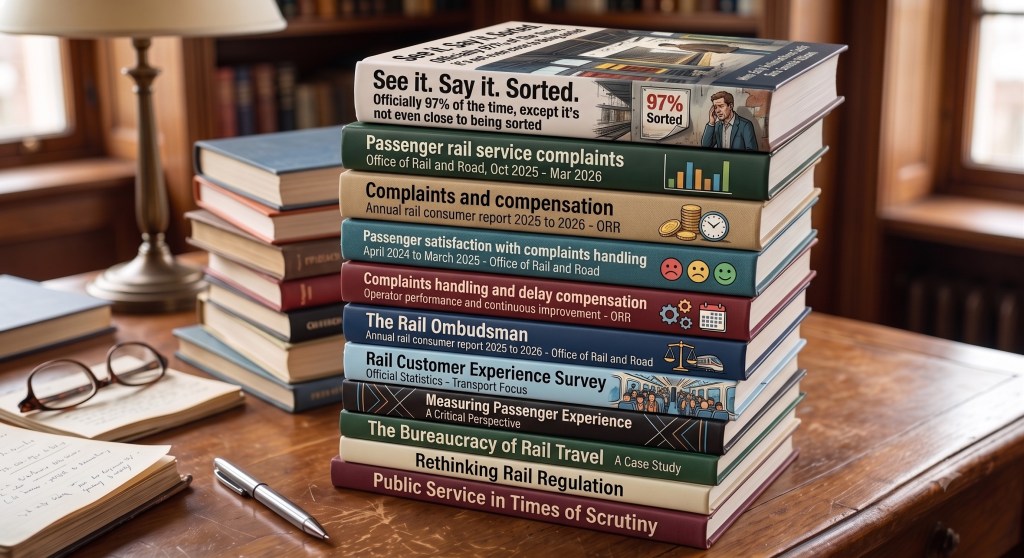
Sources and relevant reading for See it. Say it. Sorted. Officially 97% of the time, except it’s not even close to being sorted
- 25 June 2026 – Passenger rail service complaints, October 2025 to March 2026 – Office of Rail and Road
This is the main source for the article’s latest complaint figures. The regulator reports 336,332 complaints in 2025-26, up 4% on the previous year, with 97.2% dealt with within 20 working days. It is directly relevant to the article’s question about what a strong response-time figure actually tells us. (ORR Data Portal) - 9 July 2026 – Complaints and compensation – Annual rail consumer report 2025 to 2026 – Office of Rail and Road
The regulator describes performance against its complaint response requirements as “generally good”, with 97% of complaints answered within 20 working days and 73% within ten. The same report also says operators need to examine passengers’ experience of the complaints process and the impact of improvements, which is central to the article’s argument. (Office of Rail and Road) - 5 August 2025 – Passenger satisfaction with complaints handling, April 2024 to March 2025 – Office of Rail and Road
This is the source for the passenger satisfaction figures used in the article: 31% satisfied with how the complaint was handled and 29% satisfied with the result. It also reports that only 28% thought their complaint had been fully addressed and 27% thought the operator seemed keen to reach an acceptable outcome. Those findings illustrate the difference between receiving a response and feeling that a complaint has actually been sorted. (ORR Data Portal) - 31 October 2025 – Complaints handling and delay compensation: Operator performance and continuous improvement actions 2024-2025 – Office of Rail and Road
This report is particularly relevant to the article’s wider argument. The regulator found no widespread concern with complaint response times, while saying that satisfaction with complaint handling remained too low. It also found that more than half of operators did not adequately explain how they assessed passengers’ experience of the complaints process or measured the effect of improvements. (Office of Rail and Road) - 9 July 2026 – The Rail Ombudsman – Annual rail consumer report 2025 to 2026 – Office of Rail and Road
Relevant to the article’s question about what happens after an unsatisfactory reply. The Rail Ombudsman provides an independent route for passengers whose complaints remain unresolved, making it useful background to the distinction between a company finishing its own complaints process and the passenger feeling that the matter has actually been settled. (Office of Rail and Road) - 18 June 2026 – Rail Customer Experience Survey – Official Statistics – Transport Focus
This provides broader context for the article’s argument that passenger experience needs to be measured directly, rather than inferred from internal performance figures. The survey gathered views from more than 100,000 passengers about their actual experience of rail travel and is intended to provide regular passenger-focused evidence to the industry. (transportfocus.org.uk)

Footnote Zone for See it. Say it. Sorted. Officially 97% of the time, except it’s not even close to being sorted
Disclosure: The diagnostic tools referenced below were developed by NokNok, a specialist in online responsiveness tool design.
This Footnote Zone uses NokNok’s diagnostic toolkit to test what the railway’s complaint figures may not show: whether passengers can get through, receive a useful reply and reach the point where their complaint is genuinely sorted.
- Email Finder: Cause: The article asks what happens when the first reply doesn’t sort out the complaint and the passenger has to email, call or try another route. Cure: Email Finder scans a train company’s website and other public-facing material for published email addresses, then reports missing routes, inconsistencies and other gaps that may make further written contact harder.
- Reply Radar: Cause: The 97.2% figure shows how often complaints reach the end of the official process within 20 working days, but it doesn’t show whether different contact routes produce dependable replies in practice. Cure: Reply Radar sends targeted test emails and measures whether they receive replies, how long those replies take and how consistently different enquiries are answered.
- Compliance Sniffer: Cause: The article points out that a fast but irrelevant answer can still meet the deadline, while a polite explanation that changes nothing still counts as a reply. Cure: Compliance Sniffer examines incoming responses for clarity, relevance, completeness, useful next steps, escalation and compliance, separating an answer that merely arrived on time from one that actually deals with the complaint.
- Mystery Shopper: Cause: The article asks what happens after the first reply: whether passengers have to chase again, contact somebody else, accept an answer they dislike or simply give up. Cure: Mystery Shopper follows the whole complaint journey as a real passenger would, testing the contact route, the reply, any repeat contact and the route for taking an unresolved complaint further.
Disclosure: The diagnostic tools referenced in this Footnote Zone were developed by NokNok, a specialist in online responsiveness tool design. ReplyResearch may use NokNok tools, resources or analysis when preparing coverage, while retaining responsibility for its editorial decisions, including what topics to cover, what sources to cite and how stories are presented. Read the full ReplyResearch Collaborative Disclosure Policy here.
One point I have not fabricated: the specification’s standard Email Finder mapping talks about organisations hiding email addresses or forcing people through obstructive forms, but this particular rail article doesn’t make that claim. I’ve therefore tied Email Finder to the article’s actual issue – needing another contact route when the first reply fails – rather than pretending that the article found hidden rail contact details.


