

 Peter Friedman
More than 400,000 people in England are waiting for assessments, support or reviews. Yet the statistics reveal almost nothing about unanswered calls, missing updates, failed callbacks or whether anybody still owns the case.
The Crisis Behind The Queue
The social care crisis is normally described through funding gaps, workforce shortages and waiting lists. All are real, but they can obscure another failure: the exhausting struggle to obtain a useful response.
ADASS published its Spring Survey 2026 on 15 July 2026, estimating that 408,985 people were awaiting assessments, support, direct payments or reviews, while describing the aspiration that people should be “waiting well”.
The report explained “waiting well” as waiting “safely and in an informed way”. That phrase quietly establishes a communication standard: people should know what is happening, who is responsible and what happens next.
Yet national waiting statistics cannot reveal whether somebody has received an acknowledgement, a realistic timescale, a named contact or instructions for reporting deterioration. They measure unfinished work, not the experience of being left unfinished.
Waiting Has A Communication Problem
Waiting for social care is not comparable with waiting for an ordinary transaction. Needs may worsen, carers may burn out and safe arrangements may collapse while an assessment, review or care package remains unresolved.
The ADASS survey found 199,789 people waiting for assessments, including 58,921 waiting beyond six months. It also estimated that 185,460 care-plan reviews were overdue by more than twelve months.
Those figures describe duration, but not contact. Someone receiving regular explanations and risk checks occupies the same statistical category as someone repeatedly calling an unanswered number and receiving no meaningful update.
That difference should matter. Silence can leave families unsure whether the case remains active, whether missing information is delaying it, or whether deterioration has raised the person’s priority within an overstretched system.
The Newest Evidence Exposes The Chase
Carers UK’s NHS Continuing Healthcare briefing, published on 26 June 2026, reported serious delays and a complex process that placed a substantial administrative burden upon people already providing unpaid care.
One respondent explained: “We do not have a named CHC manager so we speak to whoever answers the phone.” The problem was not just about delay, it was just as much about continuity and responsibility not really being what it should be.
Another reported: “Always having to repeat information to a different person”. Others described months awaiting assessments, appeals or decisions, sometimes after documents were lost or promised timescales had already passed.
These experiences belong partly to the boundary between NHS funding and social care. That boundary makes them especially revealing, because divided responsibility frequently turns ordinary contact into an exhausting search for ownership.
Nobody Owns The Conversation
A named contact cannot create care capacity, but ownership still changes the experience. It establishes where information should go, who should update the family and who should notice when circumstances deteriorate.
Without that ownership, every enquiry can restart the case. People repeat diagnoses, risks, family circumstances and previous decisions, while each new responder sees only fragments rather than a continuing human situation.
Repetition is not harmless administration. It consumes time from carers, increases opportunities for errors and can force distressed people to reconstruct painful events for professionals who may never speak to them again.
The organisation may record several completed contacts, while the person experiences no progress. Activity increases, telephone calls are answered and emails are sent, yet the central question remains unresolved and effectively ownerless.
Welcome To No Man’s Land
The King’s Fund published “No man’s land” on 2 June 2026, describing the health and social care interface as somewhere people experience “delays, confusion and gaps in support”, particularly during transitions.
Those transitions include hospital discharge, changing needs and decisions about Continuing Healthcare. Each may involve councils, NHS bodies, providers, assessors and families, with different eligibility rules, budgets and lines of accountability.
Fragmentation therefore becomes a responsiveness problem. An organisation can answer correctly within its own narrow remit while leaving the person no closer to discovering who can provide the answer that actually matters.
A technically accurate referral elsewhere may still be unhelpful when the receiving service rejects responsibility, lacks the necessary information or expects the family to begin another process without guidance or continuity.
The Front Door May Be Decorative
Healthwatch England stated on 31 March 2025 that the social care system can be “difficult to understand and navigate”. Many people did not know whether support existed or where they should begin.
This is reachability before contactability. Publishing a council telephone number or online directory does not create meaningful access when people cannot identify the correct service, understand eligibility or formulate the required request.
The Department of Health and Social Care’s Adult Social Care Survey, updated on 4 February 2026, found that 12.1 per cent of information-seeking service users found information “very difficult to find”.
That survey concerned people already receiving long-term support. It cannot fully represent those outside the system who are uncertain about entitlement, unable to identify the front door or discouraged before making contact.
Unpaid Carers Become Unpaid Coordinators
The Health Foundation’s UK analysis, published on 27 February 2026, estimated that 8.9 million adults provided unpaid care during 2023–25, equivalent to approximately one in six UK adults.
It linked limited support partly to “low public awareness of government support and poor identification of carers by health and care services”. Both are failures of proactive communication as well as policy.
When formal services are fragmented, families become the connecting infrastructure. They carry messages, compare accounts, preserve records, chase decisions and explain one organisation’s position to another organisation that should already understand it.
This invisible coordination is rarely treated as part of the cost of social care. Yet every unanswered message and failed hand-off transfers administrative work towards people already carrying substantial emotional and practical responsibilities.
Assessment Is Not The Same As Support
Carers UK’s State of Caring report, published on 20 February 2025, found only 23 per cent of respondents had completed a Carer’s Assessment during the preceding twelve months.
Among those assessed, 42 per cent said their local authority had not supported them afterwards. The assessment therefore risked becoming an administrative event that recorded need without producing a useful continuing response.
The same research found 57 per cent experienced long waits for support, while 51 per cent said services were unavailable when required. Delay, scarcity and weak follow-through were closely entangled.
A completed assessment may look like responsiveness within performance reporting. For the carer still awaiting respite, equipment, information or a decision, however, the meaningful question is whether anything helpful happened afterwards.
Complaints Reveal The Hidden Experience
The Local Government and Social Care Ombudsman published its adult care review on 18 September 2025, reporting an eight per cent caseload increase and upholding 79 per cent of investigated complaints.
The Ombudsman said many cases highlighted “poor communication with service users and their loved ones”. It called for clear, timely and compassionate communication from councils and care providers.
Complaints are an incomplete window because many people never escalate concerns. Some do not know the route, lack energy, fear damaging relationships or regard another complicated process as more burden than remedy.
Even so, the high uphold rate suggests communication failures are not peripheral irritations. They accompany substantive problems involving assessments, care planning, charging, residential care and the handling of vulnerability.
Local Inspections Find The Same Pattern
The Care Quality Commission’s Lancashire assessment, published on 15 August 2025, found some people had difficulty reaching practitioners and “getting through to an appropriate member of staff” without an existing named contact.
It also heard about repeated changes of practitioner, limited continuity and people having to explain themselves frequently. Contactability weakened precisely when a familiar professional was absent or responsibility moved.
In Ealing, the CQC reported on 17 January 2025 that some people found it “difficult to get in touch with the local authority”, alongside concerns about access and timeliness.
These findings matter because they identify operational mechanisms, not merely dissatisfaction. Central numbers, changing practitioners, inaccessible information and weak continuity can convert system pressure into repeated communication failure for individuals.
The Numbers Cannot See Silence
Adult social care reporting can count requests, assessments, services, reviews, expenditure and outcomes. It appears much less able to describe what happens communicatively between the initial request and the eventual decision.
There is no prominent national measure for unanswered emails, abandoned calls, missed callbacks, repeated chasing, unexplained transfers, contradictory answers, absent case owners or enquiries closed without the person understanding why.
Consequently, a council reducing a backlog may appear to improve while still leaving people poorly informed. Another may communicate carefully during unavoidable delays without receiving meaningful recognition for that work.
The absence of measures also weakens accountability. Organisations can discuss waiting volumes without answering whether people know they are waiting, why they are waiting or how to make renewed contact safely.
Contactability Matters More During Scarcity
It may seem unfair to emphasise communication when social care teams face insufficient capacity. Yet scarcity strengthens rather than weakens the case for reliable acknowledgement, ownership, prioritisation and updates.
People can often tolerate an unwelcome answer better than unexplained silence. A realistic timescale permits planning, while a named escalation route helps families report changes before a manageable situation becomes an emergency.
Good communication will not manufacture care workers or funding. It may nevertheless reduce duplicated calls, repeated storytelling, avoidable complaints, confused referrals and crises caused by nobody recognising that circumstances have changed.
The alternative is expensive contact theatre: numerous channels, portals, directories and automated acknowledgements creating the appearance of accessibility while the person remains unable to obtain an accountable, useful response.
What Would Responsiveness Actually Measure?
A serious responsiveness measure might begin with acknowledgement. Did the organisation confirm receipt, explain the next stage, provide a timescale and identify what the person should do if immediate safety became uncertain?
It would then examine ownership. Was somebody or some clearly identified team accountable for progressing the case, coordinating information and communicating changes, rather than merely passing each enquiry onwards?
Helpfulness would require more than answering. Did the response address the person’s real question, explain eligibility or refusal clearly, distinguish confirmed information from uncertainty and offer a workable next action?
Continuity would test whether people had to restart after staff changes or organisational transfers. A system cannot claim successful contact when every interaction requires the individual to reconstruct the entire history.
The Reply Gap Becomes A Care Risk
In commercial customer service, an unanswered enquiry can damage trust or revenue. In social care, the same communication failure may contribute to injury, carer breakdown, hospital admission or an avoidable safeguarding crisis.
That does not mean every delay causes harm, or every communication problem reflects indifference. It means communication is part of risk management when people’s needs can change while resources remain unavailable.
The ADASS phrase “waiting well” therefore deserves much more attention. Waiting safely and in an informed way should be treated as a measurable experience, not a reassuring assumption attached to a queue.
Without evidence about acknowledgements, updates, ownership and helpfulness, nobody can know how many people are genuinely waiting well and how many are simply waiting, chasing and gradually becoming less safe.
This Is Primarily English Evidence
Social care is devolved, and the strongest comparable administrative evidence examined here concerns England. It would be misleading to present English council, Ombudsman and CQC findings as measurements of one uniform UK system.
Nevertheless, the Health Foundation’s UK-wide analysis shows that reliance on unpaid care crosses national boundaries. Carers Scotland’s State of Caring 2024 also reported long waits for assessments, reviews, care and support.
The underlying ReplyResearch question therefore travels beyond one administration. Wherever responsibility is distributed between public bodies, providers and families, weak contactability can magnify shortages and make entitlements practically inaccessible.
A fuller UK comparison would need separate evidence from Scotland, Wales and Northern Ireland, paying very close attention not just to formal access but also to whether people can reach accountable decision-makers and obtain useful answers.
Reform Needs A Reply Test
Social care reform will understandably focus on funding, workforce, eligibility and integration. It should also ask whether people can discover support, reach the responsible service and receive a timely, comprehensible and helpful answer.
A system may remain unable to provide everything immediately. It should still be possible to tell people what has happened to their request, who owns it and when they will hear again.
The central test is not whether a contact channel exists. It is whether contact begins a dependable process of acknowledgement, ownership, explanation and follow-through, rather than another round of searching and chasing.
Social care does not only leave people waiting. Too often, the evidence suggests, it leaves them performing the administrative labour of keeping their own unresolved need visible to the organisations responsible for addressing it.
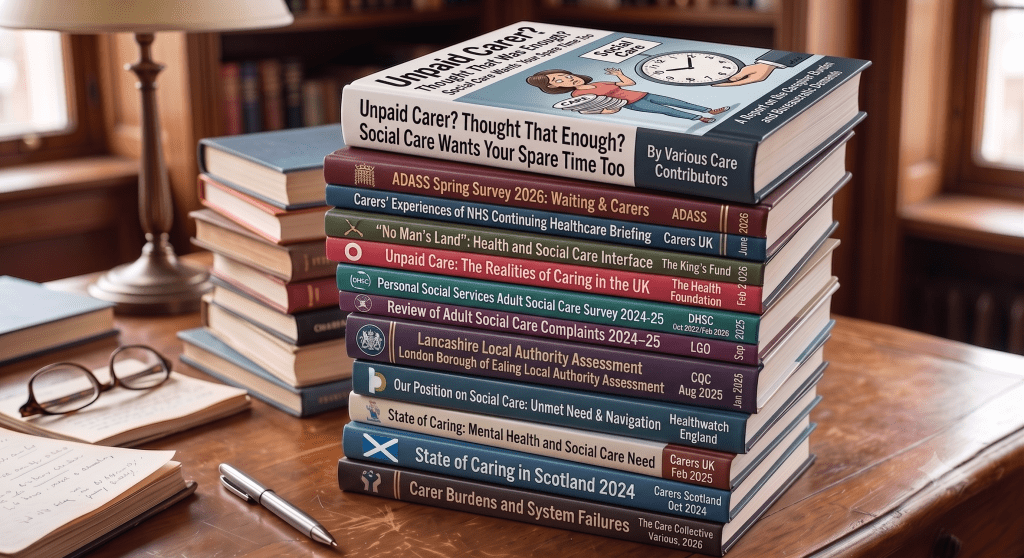
Sources And Relevant Reading for ReplyResearch article: Unpaid Carer? Thought That Was Enough? Social Care Wants Your Spare Time Too
Newest Research
Association of Directors of Adult Social Services, ADASS Spring Survey 2026, published 15 July 2026. The report provides waiting estimates, discussion of “waiting well” and findings concerning carers.
https://www.adass.org.uk/wp-content/uploads/2026/07/ADASS-Spring-Survey-2026-Final-1-1.pdf
Carers UK, Carers’ Experiences of NHS Continuing Healthcare Briefing, published 26 June 2026. The briefing examines navigation, continuity, delays, administrative burdens and carers’ experiences of slow or absent responses. https://www.carersuk.org/media/z5ahqf4o/carers-experiences-of-nhs-continuing-healthcare-briefing.pdf
The King’s Fund, “No Man’s Land”: The Experience of Patients at the Interface Between Health and Social Care, published 2 June 2026. The analysis examines delays, confusion and fragmented responsibility.
The Health Foundation, Unpaid Care: The Realities of Caring in the UK, published 27 February 2026. The analysis covers the scale of caring and limited access to support.
Official And Regulatory Evidence
Department of Health and Social Care, Personal Social Services Adult Social Care Survey, England, 2024 to 2025, published 30 October 2025 and updated 4 February 2026.
Local Government and Social Care Ombudsman, Review of Adult Social Care Complaints 2024–25, published 18 September 2025. The review covers complaint volumes, uphold rates and communication concerns
Care Quality Commission, Lancashire County Council Local Authority Assessment, published 15 August 2025. The assessment discusses difficulty reaching practitioners, limited continuity and repeated explanations.
https://www.cqc.org.uk/care-services/local-authority-assessment-reports/lancashire-0825/summary
Care Quality Commission, London Borough of Ealing Local Authority Assessment, published 17 January 2025. The assessment records reported difficulty contacting the authority and accessing support.
https://www.cqc.org.uk/care-services/local-authority-assessment-reports/ealing-0125/summary
Carers And Navigation
Healthwatch England, Our Position on Social Care, published 31 March 2025. The evidence discusses unmet need, difficult navigation and uncertainty about available support or where to find it.
https://www.healthwatch.co.uk/news/2025-03-31/our-position-social-care
Carers UK, State of Caring: The Impact of Caring on Carers’ Mental Health and the Need for Support from Social Care Services, published 20 February 2025.
Carers Scotland, State of Caring in Scotland 2024. The report examines access to services, support for unpaid carers and long waits for assessments, reviews, care or support.
https://www.carersuk.org/media/j1bnykxm/state-of-caring-health-and-social-care-2024.pdf

Footnote Zone for Unpaid Carer? Thought That Was Enough? Social Care Wants Your Spare Time Too
Disclosure: The diagnostic tools referenced below were developed by NokNok, a specialist in online responsiveness tool design.
This Footnote Zone uses NokNok’s diagnostic toolkit to examine how the systemic social care communication breakdowns and response failures detailed in this article can be identified, measured, and systematically addressed.
- Email Finder: Social care organizations frequently obscure contact routes, publish decorative front doors, or leave families navigating central numbers without a direct path to a named professional or active mailbox. Email Finder scans an organization’s website and public-facing materials for published email addresses, reporting structural deficiencies, missing contact routes, and contactability gaps that force unpaid carers into chasing support.
- Reply Radar: Unanswered calls, unacknowledged requests, and severe delay leave over 400,000 individuals trapped in silent queues with no timeline or confirmation of active case status. Reply Radar deploys targeted test emails and quantitatively measures reply rates, latency, response consistency, and key responsiveness benchmarks across service channels.
- Compliance Sniffer: Automated acknowledgements, evasive standard replies, and generic responses fail to provide meaningful updates, clear eligibility guidance, or safety instructions for deteriorating conditions. Compliance Sniffer analyzes incoming responses for objective quality, clarity, relevance, escalation pathways, and compliance benchmarks to ensure communication provides genuine accountability.
- Mystery Shopper: Complex health-and-care interfaces, defensive gateways, fragmented hand-offs, and absent case ownership force families to act as unpaid coordinators re-explaining their history at every contact. Mystery Shopper executes a comprehensive end-to-end responsiveness UX audit, testing how a real user experiences the organization’s contact, response, and escalation pathways.
Disclosure: The diagnostic tools referenced in this Footnote Zone were developed by NokNok, a specialist in online responsiveness tool design. ReplyResearch may use NokNok tools, resources, or analysis when preparing coverage, while retaining responsibility for its editorial decisions, including what topics to cover, what sources to cite, and how stories are presented. Read the full ReplyResearch Collaborative Disclosure Policy here.


