


This is hopefully the first of many for us, a ReplyResearch Guest Author, Rachel Matthews
When my husband experienced complications after eye surgery, I hoped that telling the organisation what had happened might help us understand it and reduce the chance of somebody else suffering similarly.
I am a nurse by background, so I knew formal complaints could become difficult and exhausting. I began informally, hoping that a straightforward conversation might be enough to encourage reflection.
The first meeting felt encouraging. We came away believing our concerns had been heard, although we still needed reassurance that the incident had been recorded and the consent process considered.
Then nobody replied
I sent a follow-up email asking for that reassurance. Nobody replied. Days became weeks, weeks became months, and eventually more than a year passed without any meaningful response.
The silence was confusing because contact had initially seemed possible. We had met people, explained what happened and asked specific questions, yet the conversation appeared to vanish once we left.
I could not tell whether the case was being reviewed quietly, passed between departments, forgotten completely or regarded as unimportant. The absence of information left every possibility open.
A process without a person
With my husband’s reluctant permission, I eventually submitted a formal complaint. A reference number arrived automatically, together with a promise that we would receive a response within twenty-five working days.
That acknowledgement briefly restored my confidence. It suggested the complaint had entered a recognised process and that somebody, somewhere, would take responsibility for returning to us with an answer.
The deadline passed without contact. I emailed the Patient Advice and Liaison Service one month later, then again another month afterwards. Neither message brought an explanation, update or revised timescale.
Reachable, but not reached
I began to understand that being able to send an email is not the same as being able to reach an organisation. Technically, the route remained open; humanly, it felt closed.
Each unanswered message created another decision for us. Should we wait, chase again, escalate elsewhere or stop? The organisation’s silence gradually transferred responsibility for keeping the complaint alive onto us.
Eventually, we stopped pursuing it proactively. That was not because the questions had been answered or the experience no longer mattered. We stopped because protecting our wellbeing mattered more.
Not just our experience
Later, I discovered that our experience was far from unusual. Healthwatch England reported in 2025 that more than half of people experiencing poor NHS care took no action afterwards.
Among those who did not complain, one third believed organisations would not respond effectively. Reading that finding, I wondered how many potentially important stories disappear because people expect silence.
The same research found widespread dissatisfaction among those who did complain. That made our withdrawal feel less like an individual failure and more like a predictable response to an exhausting system.
A 2024 systematic review offered some possible explanations, including limited time, unclear authority, insufficient training, emotional pressures, weak managerial support and organisational cultures that undervalue complaints.
What silence added
Those findings helped me resist assuming that an individual deliberately ignored us. I still do not know what happened behind the scenes, but the effect of the silence remained the same.
The Parliamentary and Health Service Ombudsman calls the additional distress caused by poor responses after healthcare harm “compounded harm”. That phrase closely reflects what our family experienced.
The 2025 Dash review also identified delayed and poor-quality complaint responses, alongside limited published information. Our unanswered correspondence seems to sit within a wider difficulty, not outside it.
What might have helped
What would have helped us was surprisingly modest: a named person, an honest timescale and occasional updates. Even a message explaining the delay would have shown that our concerns remained visible.
We did not expect certainty, instant agreement or a perfectly tidy explanation. We wanted somebody to acknowledge the substance of what happened and tell us whether anything might be learned.
A meaningful response might also have explained what was known, what remained uncertain and whether any change followed. Without that feedback, we cannot tell whether sharing our experience achieved anything.
Why am I still telling this story?
We now tell family and friends to ask questions, pause when uncertain and be clear about what matters to them. I wish that advice had grown from confidence rather than disappointment.
I still believe patients and families can contribute to safer care by describing what happened. However, that contribution depends upon someone receiving the story, staying in contact and eventually replying.
Perhaps the most useful question for NHS organisations is not simply whether complaints are acknowledged. It is whether the people behind them feel heard, remembered and worth returning to.
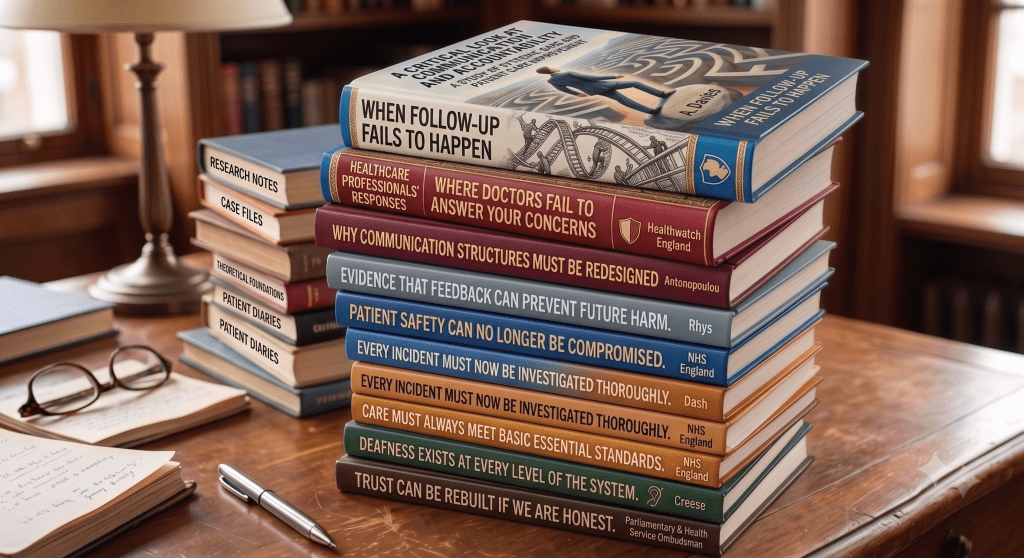
Sources and relevant reading for NHS Initial Response? Good. Follow-Up? What Follow-Up?
- A Pain to Complain: Why It’s Time to Fix the NHS Complaints Process – Healthwatch England, 27 January 2025. This is particularly relevant to the author’s experience of waiting and eventually disengaging. It found that 56% of people experiencing poor NHS care took no action, while 33% of non-complainants doubted organisations would respond effectively. It also found average complaint-response times of 54 working days among integrated care boards, with considerable variation.
- Understanding Healthcare Professionals’ Responses to Patient Complaints in Secondary and Tertiary Care in the UK – Antonopoulou and colleagues, 1 October 2024. This systematic review identifies factors affecting effective complaint handling, including communication skills, procedural knowledge, available time, resources, authority, managerial support, organisational culture and staff emotions. It supports the article’s suggestion that silence may reflect systemic weaknesses rather than the deliberate actions of one individual.
- Harnessing the Power of Language to Enhance Patient Experience of the NHS Complaint Journey in Northern Ireland – Rhys and colleagues, National Institute for Health and Care Research, September 2024. This mixed-methods study examined complainants’ lived experiences, including correspondence, telephone conversations, diaries and interviews. It found that each interaction can reshape the entire complaint journey and that poorly constructed written responses can have an especially negative effect.
- Data on Written Complaints in the NHS, 2024–25 – NHS England, 16 October 2025. These official statistics recorded 256,777 written NHS complaints during 2024–25, an increase of 6.1% from the previous year. Communication was the largest complaint category within hospital and community health services, reinforcing the wider relevance of responsiveness and follow-up.
- Review of Patient Safety Across the Health and Care Landscape – Dr Penny Dash and the Department of Health and Social Care, 7 July 2025. The review examines fragmentation, duplication and unclear accountability across England’s patient-safety system. Its recommendations for clearer responsibility and stronger accountability are relevant to the author’s uncertainty about who, if anyone, retained ownership of the complaint.
- Patient Safety Incident Response Standards – NHS England, originally published 11 June 2024 and updated 29 January 2026. The standards say that people affected by safety incidents should receive a named contact, realistic timescales, explanations for delays and updates at agreed milestones. These expectations closely reflect the modest forms of communication the author says would have helped.
- Minimum Standards for Planned Patient Care – NHS England, 3 July 2026. Although these standards concern planned care rather than complaint handling specifically, they establish a timely benchmark for patients knowing what is happening and who they can contact. They demonstrate that reliable updates and clear points of contact are now recognised as central parts of patient experience.
- “They Say They Listen. But Do They Really Listen?”: A Qualitative Study of Hospital Doctors’ Experiences of Organisational Deafness, Disconnect and Denial – Creese and colleagues, first published online 31 May 2024, journal issue published May 2025. Although focused on hospital doctors in Ireland, the study describes communication systems that receive concerns but produce no response, stock responses or no follow-up action. It provides a useful parallel with patients’ experiences of being technically able to communicate while remaining functionally unheard.
- Broken Trust: Making Patient Safety More Than Just a Promise – Parliamentary and Health Service Ombudsman, 26 June 2023. Drawing upon serious NHS complaint investigations and family experiences, this report examines the gap between patient-safety policy and frontline practice. It is relevant to the article’s concern that an inadequate response after harm can deepen distress, undermine trust and prevent meaningful learning.

Footnote Zone for First NHS Response? Good. Follow-Up? What Follow-Up?
Disclosure: The diagnostic tools referenced below were developed by NokNok, a specialist in online responsiveness tool design.
This Footnote Zone uses NokNok’s diagnostic toolkit to examine how the responsiveness failures and abandoned complaint processes described in this article can be identified, measured, and addressed.
- Email Finder: This tool targets the issue of contact routes that remain technically open but functionally closed, leaving patients without a dedicated person or clear avenue to meaningfully follow up on their initial meetings. Email Finder scans an organization’s website and related public-facing materials for published email addresses, then reports on structural deficiencies, discrepancies, missing contact routes, or other contactability gaps.
- Reply Radar: This tool pairs with the trend of ignored follow-up messages where weeks turn into months, and official twenty-five-day response deadlines pass completely without contact. Reply Radar deploys targeted test emails and quantitatively measures reply rates, latency, response consistency, and related responsiveness benchmarks.
- Compliance Sniffer: This tool addresses the organization’s reliance on automated reference numbers that fail to produce substantive answers or meet basic communication standards. Compliance Sniffer analyzes incoming responses for objective quality, clarity, relevance, escalation, and compliance benchmarks.
- Mystery Shopper: This tool is paired with the exhausting, defensive user journey that forces patients into a systemic breakdown, requiring them to repeatedly chase updates until they abandon the complaint to protect their own wellbeing. Mystery Shopper executes a comprehensive end-to-end responsiveness UX audit, testing how a real user experiences the organization’s contact, response, and escalation pathways.
Disclosure: The diagnostic tools referenced in this Footnote Zone were developed by NokNok, a specialist in online responsiveness tool design. ReplyResearch may use NokNok tools, resources, or analysis when preparing coverage, while retaining responsibility for its editorial decisions, including what topics to cover, what sources to cite, and how stories are presented. Read the full ReplyResearch Collaborative Disclosure Policy here.


