

 Richard Hall
Complaints to business water retailers barely changed last year, yet cases escalated to the Consumer Council for Water soared by 30 per cent
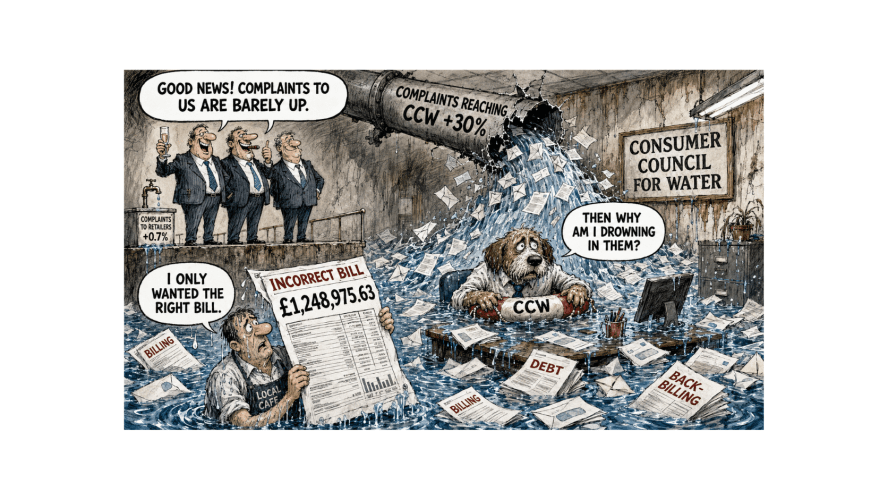
THE answer appears to be that far more customers are dissatisfied enough with the way their complaint was handled to take it further.
Businesses made 20,139 complaints directly to water retailers last year – an increase of just 0.7 per cent.
But complaints reaching the Consumer Council for Water shot up by 30 per cent, to 2,562.
In other words, the flood is not being caused by a sudden surge in initial complaints. It is being driven by complaints that retailers are failing to resolve to their customers’ satisfaction.
A new report from the Consumer Council for Water reveals that it received 2,562 complaints from business customers during 2025-26.
That is 211 per cent higher than the 824 complaints recorded before England’s competitive business water market opened in 2017.
Stage-two complaints within retailers’ own procedures also rose by 15 per cent, while referrals to independent dispute resolution doubled from 31 to 62.
CCW itself says the figures suggest some retailers are not resolving complaints effectively enough at an earlier stage.
BILLING BLACK HOLE
The competitive market allows most businesses, charities and public-sector organisations in England to choose the retailer that handles their water billing and customer service.
Competition was supposed to give them choice – and force retailers to provide a better service.
But choice is not much comfort when nobody can get the bill right.
Billing problems accounted for an extraordinary 90 per cent of all complaints escalated to CCW.
Disputes over measured bills made up more than half of its caseload and increased by 25 per cent during the year.
Complaints connected with debt rocketed by 131 per cent, while complaints about back-billing – customers being chased for charges relating to an earlier period – soared by 307 per cent.
A wrong bill is one problem. Having to battle through multiple complaint stages to get somebody to deal with it is another.
And the complaints maze is evidently confusing.
In 62 per cent of cases brought to CCW, the customer had not completed every stage of the retailer’s internal procedure and had to be advised or directed back to it.
CCW says this can happen because the procedure has not been explained clearly, because customers are dissatisfied with how their complaint is being handled, or because they are frustrated by the communication they have received.
A complaints procedure so unclear or exasperating that customers approach the watchdog before they are officially entitled to do so is not evidence of successful customer service.
WORST PERFORMERS NAMED
CCW identified SES Business Water, Clear Business Water, Castle Water and Water Plus as the large and medium-sized retailers generating the highest complaint rates relative to their customer numbers.
SES Business Water recorded 21.6 escalated complaints for every 10,000 customer connections. Clear Business Water recorded 20.4 and Castle Water 18.3.
The next highest, Water Plus, recorded 9.3 – meaning the third-worst performer generated almost twice its rate of complaints.
CCW says it is holding regular meetings with Castle Water and supporting its improvement plan. Clear Business Water has also agreed a plan and timetable to address its performance.
The consumer body said it now expected “constructive engagement” from SES Business Water.
At the other end of the table, CCW placed ADSM, Water2Business and Source for Business among the market’s stronger performers – proof that dreadful complaint handling is not inevitable.
CHOICE ISN’T ENOUGH
The increase does not prove that competition itself caused every additional complaint. Customer awareness, market changes and people’s willingness to escalate problems can all affect the figures.
But it demolishes any complacent suggestion that introducing competition automatically produces responsive customer service.
A competitive market cannot be judged merely by the number of supplier names appearing on a website.
It should be judged by whether bills are accurate, questions receive answers and mistakes are corrected without customers having to become professional complainers.
Nine years after the market opened, complaints reaching the consumer body are more than three times their previous level.
The water market may not be facing a flood of new complaints.
It is facing a flood of complaints it failed to resolve before they became somebody else’s problem.
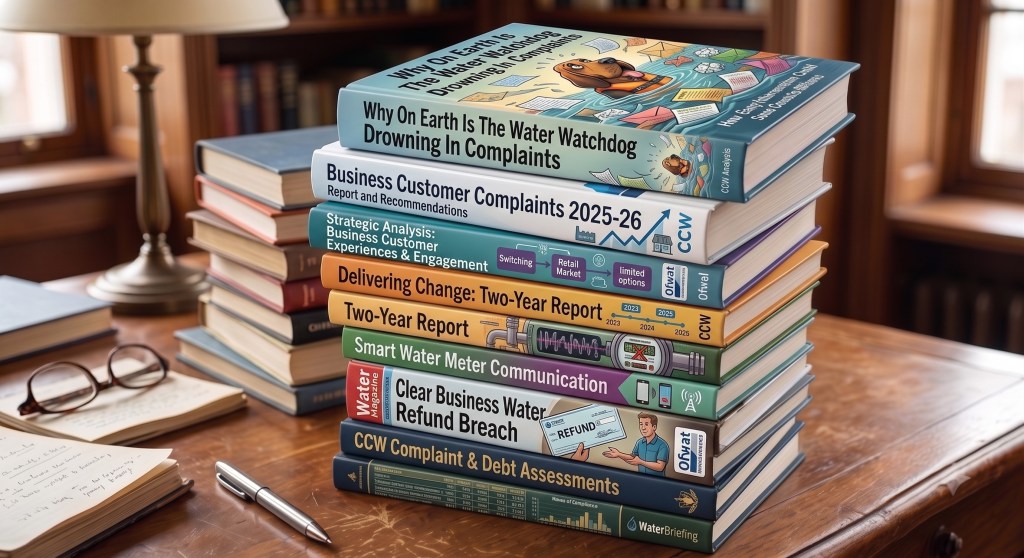
Sources and relevant reading for
Why On Earth Is The Water Watchdog Drowning In Complaints?
- Business Customer Complaints 2025-26 – Consumer Council for Water, 21 July 2026.
The primary source for the article’s central figures: 20,139 complaints made directly to retailers; the 30 per cent rise to 2,562 cases escalated to CCW; increases in stage-two, debt and back-billing complaints; billing’s 90 per cent share of escalated cases; retailer performance comparisons; and CCW’s explanation of complaints brought to it before internal procedures were exhausted. - Business customer experiences and engagement in the water retail market – Consumer Council for Water and Ofwat, 27 October 2025.
Provides evidence relevant to the article’s “choice isn’t enough” argument. Research involving more than 1,700 businesses found that only 15 per cent were satisfied with the water industry, awareness and participation in the retail market remained limited, and many smaller businesses found switching difficult or not worth the effort. - Delivering change: two-year progress report for business water customers – Consumer Council for Water, 30 September 2025.
Places the complaints problem in the history of the competitive market, which opened in 2017. It identifies accurate meter readings and billing as continuing priorities, describes reforms intended to improve service and says further action is still needed on binding dispute resolution involving wholesalers. - Business customers’ smart water meter communication – Consumer Council for Water, 16 April 2026.
Adds context to the article’s focus on measured-bill disputes. CCW found that the potential benefits of smart water meters were being weakened by unclear communications, inconsistent access to consumption data and low customer engagement. - Clear Business Water to refund customers after back billing breach identified by Ofwat – Water Magazine, 27 March 2026.
Provides a recent, concrete example of the back-billing problem highlighted in the article. It reports that an Ofwat compliance review found Clear Business Water had billed some customers beyond the permitted period. The retailer identified approximately 309 affected customers and began arranging credits or refunds. - CCW publishes summaries of latest wave of complaint and debt assessments with water companies – WaterBriefing, 9 April 2026.
Provides relevant wider water-industry evidence about complaint handling, although it concerns household water companies rather than the business-retail figures used in the article. CCW warned that cases can be closed before every required action has been completed, leaving customers to chase responses and updates, and called for clearer timescales and expectations.

Footnote Zone for Why On Earth Is The Water Watchdog Drowning In Complaints?
Disclosure: The diagnostic tools referenced below were developed by NokNok, a specialist in online responsiveness tool design.
This Footnote Zone uses NokNok’s diagnostic toolkit to examine why business-water complaints are escalating beyond retailers and how failures in contactability, response handling, message quality and complaint-path design can be identified, measured and addressed.
- Email Finder – Cause: In 62 per cent of cases brought to CCW, customers had not completed every stage of their retailer’s complaints procedure, with unclear signposting identified as one possible reason. This raises a practical question about whether retailers publish accessible routes to the correct complaints team and escalation stage. Cure: Email Finder scans each retailer’s website and related public-facing materials for published email addresses, then reports missing contact routes, contradictory information, structural deficiencies and other contactability gaps.
- Reply Radar – Cause: Direct complaints increased by only 0.7 per cent, while cases escalated to CCW rose by 30 per cent and stage-two complaints increased by 15 per cent. The divergence points to problems remaining unanswered or unresolved within retailers’ own systems. Cure: Reply Radar deploys targeted test emails to retailers and quantitatively measures reply rates, response latency and consistency, allowing their responsiveness performance to be compared over time and against one another.
- Compliance Sniffer – Cause: Billing generated 90 per cent of complaints escalated to CCW, while debt-related and back-billing complaints rose sharply. In such cases, receiving a reply is not enough: the response must address the disputed charge clearly, explain the evidence and provide a workable route to correction or escalation. Cure: Compliance Sniffer analyzes incoming responses against objective benchmarks for quality, clarity, relevance, escalation and compliance, distinguishing substantive engagement from acknowledgements, empty platitudes and evasive answers.
- Mystery Shopper – Cause: The article describes a complaints maze in which customers can become frustrated with communication or approach CCW before completing every internal stage, only to be directed back into the retailer’s procedure. Cure: Mystery Shopper executes a comprehensive end-to-end responsiveness UX audit, testing how a real user finds a contact route, submits a billing complaint, navigates forms and gateway filters, receives a response and escalates an unresolved problem.
Disclosure: The diagnostic tools referenced in this Footnote Zone were developed by NokNok, a specialist in online responsiveness tool design. ReplyResearch may use NokNok tools, resources or analysis when preparing coverage, while retaining responsibility for its editorial decisions, including what topics to cover, what sources to cite and how stories are presented. Read the full ReplyResearch Collaborative Disclosure Policy.


