

 Stephen Walters
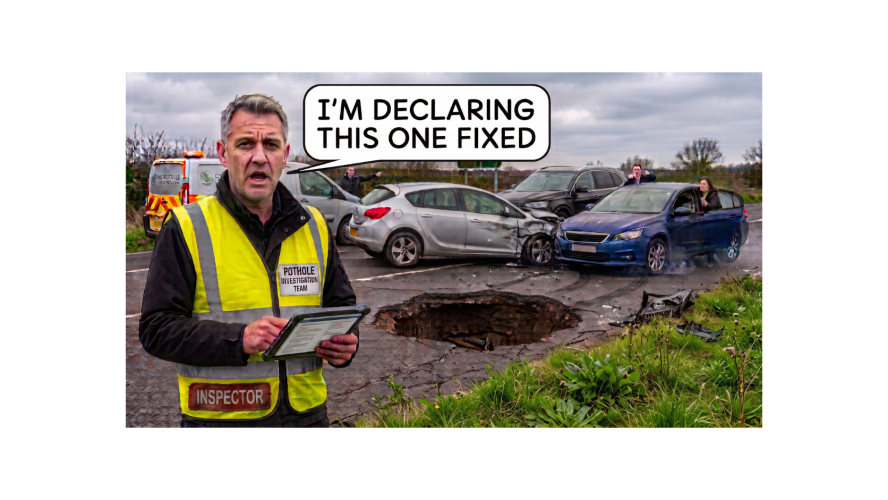
Oh yeah, just tell everyone that you’ve now fixed those extremely dangerous holes we reported to you in good faith. And if it turns out that you haven’t done anything, so what? Just let everyone know that they’re fixed. This is The Oxfordshire Council Solution
Here’s what happens: Residents report a dangerous crater, then the council proudly proclaims online that they’ve ‘actioned it to be fixed’.
Then the council dutifully changes that reported road hazard’s online status to ‘investigation complete’ and then they immediately shut down their online public conversation about it.
But is that problem guaranteed to be actually sorted? Hmmmm
That phrase ‘actioned to be fixed’ doesn’t actually mean that anyone ‘actually’ fixed anything at all, and ‘completing an investigation’ has absolutely nothing to do with diligently splodging any kind of treacherously gaping hole in the road with the appropriate amount of smelly black goo.
But if you look at the website, everything now looks impressively sorted. In fact, a January 2026 report from Oxfordshire County Council reveals exactly what is happening.
A 44-minute miracle
That report noted that an “interim intervention” could count as fixed from the council’s risk-management perspective, even when “permanent work remained outstanding”.
At 8.04am on Tuesday, a resident reported a worsening pothole on a bus route. The council quickly replied that they had actioned the defect to be fixed.
By 8.48am, just 44 minutes later, the council updated the status to investigation complete and marked the case closed. There was absolutely no public confirmation of an actual physical repair.
In another situation, a resident reported a pothole on the A4095 which they said the council had outlined in paint for months. They warned that cars were actually swerving to avoid it.
Vanishing complaints
The resident added that the hole posed a particular danger to cyclists. The council actioned the hole to be fixed, then they marked the investigation complete and closed the case.
Again, the website just showed an intention to repair the road. It offered absolutely no confirmation that the repair had actually happened in the real world.
One really frustrated resident said an earlier complaint had simply disappeared from the website after ten weeks. The holes were still there and the road surface was continuing to break up.
The council also actioned the replacement complaint to be fixed, before marking the investigation complete and declaring the case closed. Declaring a case closed doesn’t prove that the hole was ignored.
A ridiculously bureaucratic outcome
But it does mean that the public conversation stops before residents get any visible confirmation of the outcome. That really matters because of Oxfordshire’s own road-repair guidance.
That guidance tells residents that they will be notified once a qualifying pothole has actually been filled. So yeah, this hides unresponsiveness inside a response.
The council hasn’t just completely ignored the resident, because they’ve answered, classified the complaint and apparently passed the problem into their internal repair system.
But they cut off the public conversation before confirming that the promised work is done, so the resident gets a bureaucratic outcome instead of a physical repair.
Waiting for the holy grail: a permanent fix
As a subsequent officer report from Oxfordshire County Council acknowledged, defects on the roads were sometimes being “prematurely closed on the system without being completed”.
In March, councillors again raised concerns about reports being closed before residents could actually see a physical repair on their local streets. They recommended keeping the notifications for residents open.
Officers explained that closures could result from temporary emergency work or a defect being transferred into a broader programme, but they accepted that the workflow and messages needed improvement.
The council says that 97% of its pothole repairs are permanent first-time fixes and that they physically inspect 20 per cent of completed repairs.
Fixing the road
Those figures might describe the quality of work once a repair takes place, but they don’t answer the simpler question facing the person who reported the hole.
Has this particular pothole actually been repaired? A functioning reporting system should distinguish clearly between receiving a complaint, examining it, ordering a repair, scheduling it, and actually completing it.
It must separate those steps from actually finishing the job, because lumping those stages together under an investigation complete status totally obscures the only outcome that matters to a road user.
A pothole isn’t repaired just because a database has stopped talking about it. Marking a case closed may tidy up the paperwork, but it doesn’t put tarmac in holes.
A national disgrace
This isn’t just an Oxfordshire problem. The UK as a whole is facing a massive infrastructure crisis that digital paperwork simply can’t fix.
The Annual Local Authority Road Maintenance survey, published in March 2026 by the Asphalt Industry Alliance, paints a grim picture. It found councils face a record £18.62 billion backlog of road repairs.
David Giles, chair of the Asphalt Industry Alliance, didn’t mince his words. He stated in the report that “all road users would agree that the condition of our local roads has become a national disgrace”.
When the problem reaches a scale where it takes 12 years to clear the backlog, marking local complaints as completed investigations feels completely disconnected from reality.
Funding the illusion
The government doesn’t even know how bad the problem really is. The National Audit Office released a damning report in July 2024 called The condition and maintenance of local roads in England.
The spending watchdog found that the Department for Transport simply lacks the knowledge to understand what local council funding is actually achieving for communities on the ground.
The National Audit Office report pointed out a stark contradiction. It noted while limited government data suggests roads are stable, “information from industry bodies and people using roads suggests that road condition is getting worse”.
This mirrors the local experience in Oxfordshire perfectly. The official databases tell a story of stable progress, while the people actually driving and cycling on the roads experience continuous physical deterioration.
Really looking for a real fix
So how does the UK actually solve this? The National Audit Office strongly suggested that the government needs to rethink its entire approach to local roads.
The spending watchdog recommended that the Department for Transport should “review its coverage requirements for local authorities on surface condition reporting”. We need data that reflects physical reality, not just administrative activity.
They also argued that local authorities need longer-term funding security, rather than having to rely on short-term pots of money. Without sustained funding, councils can’t plan permanent, cost-effective maintenance regimes.
Until national policy demands physical evidence of road repairs instead of digital checkmarks, local authorities will keep closing the paperwork while leaving the craters wide open. A digital fix just doesn’t repair a physical road.
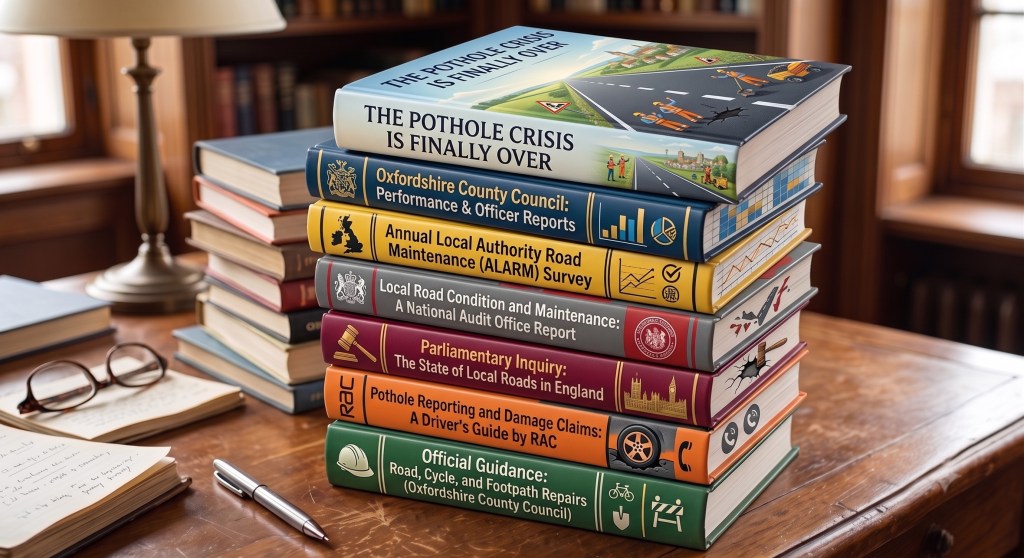
Sources And Relevant Reading For The Pothole Crisis Is Finally Over!
1. Oxfordshire County Council Officer and Performance Reports
Date: January 2026 and March 2026
Link: https://mycouncil.oxfordshire.gov.uk/documents/s80451/FixMyStreet.pdf
Relevance: These reports provide the specific local data anchoring the article’s critique of bureaucratic outcomes replacing physical repairs. They confirm the council’s practice of counting an “interim intervention” as fixed for risk-management purposes while permanent work remains outstanding. Additionally, they acknowledge concerns regarding road defects being prematurely closed on the council’s system before completion.
2. Annual Local Authority Road Maintenance (ALARM) survey
Date: March 2026
Link: https://www.asphaltuk.org/alarm-survey-page/
Relevance: Published by the Asphalt Industry Alliance, this survey provides the national context for the local reporting issues discussed, confirming a record £18.62 billion backlog in road repairs. It substantiates the article’s claim that the UK faces a massive infrastructure crisis, directly citing David Giles’s statement that local roads are a “national disgrace”.
3. The condition and maintenance of local roads in England
Date: July 2024
Link: https://www.nao.org.uk/reports/the-condition-and-maintenance-of-local-roads-in-england/
Relevance: This National Audit Office report supports the article’s assertion that the government lacks data on what local road funding actually achieves for communities. It highlights the contradiction between stable official data and the worsening physical condition of roads experienced by users. It also echoes the article’s conclusion by recommending long-term funding and better surface condition reporting that reflects physical reality.
4. Condition and maintenance of Local Roads in England (Public Accounts Committee Report)
Date: January 17, 2025
Link: https://publications.parliament.uk/pa/cm5901/cmselect/cmpubacc/349/report.html
Relevance: This parliamentary inquiry builds directly upon the July 2024 National Audit Office report featured in the article. It validates the article’s core argument that national digital data is completely disconnected from physical reality, formally concluding that the Department for Transport has insufficient knowledge of local road conditions and relies on poor data that ignores the worsening state of the roads.
5. Report a pothole and find out how to claim for damage – RAC
Date: September 1, 2025
Link: https://www.rac.co.uk/drive/advice/road-safety/report-a-pothole/
Relevance: This guide highlights how the public is instructed to interact with third-party reporting systems like FixMyStreet and local council portals to flag road defects. It provides essential context on the administrative hurdles drivers face when trying to force local authorities to transition a reported online complaint into a physical tarmac repair, underscoring the bureaucratic loop criticized throughout the story.
6. Road, cycle and footpath repairs | Oxfordshire County Council
Date: August 31, 2026
Link: https://www.oxfordshire.gov.uk/transport-and-travel/street-maintenance-z/road-repairs
Relevance: This is the official guidance from Oxfordshire County Council regarding how they handle reports of potholes and other street issues. It confirms the process mentioned in the article where users report issues via FixMyStreet and are informed about the progress. The page outlines their risk assessment criteria and states, “If the pothole or issue meets our criteria for fixing you will be notified once it has been fixed.” This directly relates to the article’s core argument about the disconnect between the council marking a report as “investigation complete” or notifying a user, and a permanent physical repair actually taking place on the ground.

Footnote Zone for The pothole crisis is finally over!
Disclosure: The diagnostic tools referenced below were developed by NokNok, a specialist in online responsiveness tool design.
This Footnote Zone uses NokNok’s diagnostic toolkit to examine how the bureaucratic dead ends and digital responsiveness failures described in this article can be identified, measured, and addressed.
- Email Finder: To address how the council deliberately shuts down public conversation and obscures ongoing communication channels after prematurely closing a report, this tool scans an organization’s website and related public-facing materials for published email addresses, then reports on structural deficiencies, discrepancies, missing contact routes, or other contactability gaps.
- Reply Radar: Because the council operates an unreliable customer-response system that ignores the physical danger of potholes while instantly closing administrative cases in as little as 44 minutes, this tool deploys targeted test emails and quantitatively measures reply rates, latency, response consistency, and related responsiveness benchmarks.
- Compliance Sniffer: To evaluate the council’s reliance on evasive responses and empty administrative platitudes like “investigation complete” that fail to meet their own road-repair communication guidance, this tool analyzes incoming responses for objective quality, clarity, relevance, escalation, and compliance benchmarks.
- Mystery Shopper: Recognizing the systemic user-experience breakdown where residents are met with defensive user journeys and disappearing complaints instead of real-world repair confirmations, this tool executes a comprehensive end-to-end responsiveness UX audit, testing how a real user experiences the organization’s contact, response, and escalation pathways.
Disclosure: The diagnostic tools referenced in this Footnote Zone were developed by NokNok, a specialist in online responsiveness tool design. ReplyResearch may use NokNok tools, resources, or analysis when preparing coverage, while retaining responsibility for its editorial decisions, including what topics to cover, what sources to cite, and how stories are presented. Read the full ReplyResearch Collaborative Disclosure Policy here.


