

 Stephen Walters
We went through the emerging official data, local evidence and the first serious evaluation of the new 111 route for emergency NHS Mental Health support. What we found is a crisis doorway that far too often just doesn’t open
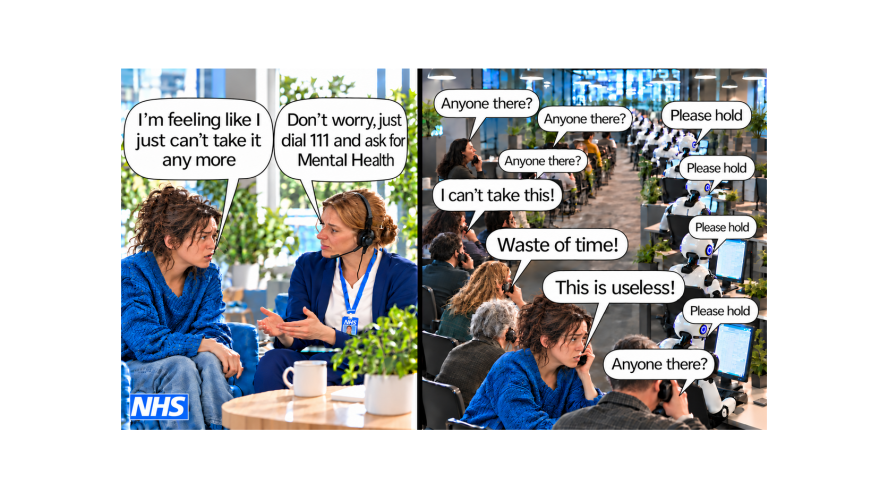
When you’re pushed to the absolute brink and feel like you can’t take it any more, the government offers a seemingly simple solution: dial 111 and press the button for urgent mental-health support.
Sources for all research publications and announcement are located further down this page
It was sold as a round-the-clock safety net, replacing the old scramble for local crisis-line numbers with one national route to trained people who could listen, assess and direct help.
On 1 October 2026, NHS England published its latest monthly mental-health helpline figures. It says the new collection should reveal “gaps or inefficiencies” and guide capacity, staffing and service planning.
What the national evidence says
Nuffield Trust’s 18 July 2025 analysis said services “differ starkly in their responsiveness”: 27% of mental-health calls were abandoned, compared with 3% of calls to mainstream 111.
That isn’t a small gap. It means that the service people are told to use in urgent psychological distress was, in the first national evidence, markedly harder to reach.
1. When a caller gives up, who knows they’re safe?
On 23 September 2025, NHS England’s collection guidance said a call only counts as answered when “a human” picks it up. It requires providers to count abandoned calls, including those after sixty seconds.
The guidance measures queue behaviour, not what followed it. It doesn’t require a public measure of whether someone was called back, reached another service, or was safely supported afterward.
NHS may have local safeguarding procedures, and some calls may end when people find help elsewhere. But ministers can’t simply assume that when 27% disconnect before a conversation starts.
The first question is therefore brutally plain: how many people wait long enough to give up, who checks whether they’re safe, and what happens if nobody can reach them?
2. Why is mental-health support slower than mainstream 111?
Nuffield’s analysis found that 94% of calls to mainstream 111 were answered in 2024/25, against 69% for the mental-health route. Within one minute, the split was 75% against 44%.
Those aren’t abstract service figures. They describe a national system where a caller seeking urgent mental-health help was far less likely to hear a human voice quickly than somebody using ordinary 111.
The postcode gap was worse. London answered 84% of calls, while the South East answered 58%; only 26% of South East calls were answered within a minute, Nuffield found.
A national telephone number shouldn’t disguise a lottery of local response. The questions are why access varies so sharply, what staffing levels underpin it, and when the weakest areas will catch up.
3. Is this a real crisis line or simply a route into another queue?
The service wasn’t created from nothing. It routes callers into pre-existing local helplines, which should make urgent support easier to find when somebody is frightened, disoriented or exhausted.
Yet the January 2026 independent London evaluation found that 45% of calls were classed as advice, consultation or information, while 34% of mental-health calls still went through mainstream 111.
Researchers said the new route had “primarily functioned as an information and signposting service”. That may help some people, but it can’t be where responsibility ends during a serious crisis.
The evaluation also said staff wanted seamless redirection, warm transfers and effective handovers. That’s plain English for a basic promise: callers shouldn’t have to keep starting again while they’re unwell.
4. Why aren’t the systems behind the number ready?
The same January 2026 evaluation found a patchwork of phone and patient-record systems. Staff sometimes had to switch between platforms to find information, which hindered both efficiency and service quality.
It also recorded significant vacancies and recruitment problems. A helpline can’t become reassuring simply because it has a memorable number; somebody qualified has to be there when it rings.
That’s why government needs to stop treating the 111 option as a completed achievement. It’s a route into a local system, and it can only be as responsive as the people and technology behind it.
Launching a common number without making the networks talk to each other risks offering callers a neat front door, followed by the same old maze.
5. Why is the promise still missing people who most need it?
In its 12 December 2025 report, Healthwatch Leeds heard from 371 people. Three in five didn’t find 111 support helpful in their crisis, while 57% who hadn’t used it didn’t know it existed.
The report said call handlers could be compassionate, but others described “long waits, accessibility barriers, and difficulties being directed to onward support”. It heard autistic, culturally diverse and D/deaf people weren’t always well served.
Rethink Mental Illness’s October 2025 report, based on 467 respondents and not nationally representative, said “83%” reported their mental health deteriorated while waiting for support.
That’s the fifth question: what use is a supposedly universal crisis route if people can’t reach it, don’t know it exists, or get through and still can’t find help?
Sources section below
Sources
Sources for “Telling them to dial 111 if they just can’t take it anymore? Not such a safe bet”
- NHS England, Access to crisis care via NHS 111 – Mental Health, August 2026, Official Statistics in Development, published 1 October 2026
Where this source appears in the article: Opening section on the new national collection and the demand for transparent performance information.
Relevant passages: The release covers “demand and call handling”, is intended to identify “gaps or inefficiencies”, and is labelled “Official statistics in development” to be “used with caution”.
Where to find them in the source: “Summary” and “Official Statistics in Development” sections. NHS England Digital
- NHS England, Urgent Mental Health Helplines Data Collection guidance, updated 23 September 2025
Where this source appears in the article: Section 1, “When a caller gives up, who knows they’re safe?”
Relevant passages: A call counts as answered only when “picked up by a human”. The guidance separately requires reporting of “Calls abandoned after 60 seconds”, alongside answer-time and abandonment measures.
Where to find them in the source: “Items required from all providers”, A03 “Number of answered calls”; “Call handling”, B02-B05 and B09.
Note: The article’s point that the collection does not itself publish a caller-follow-up or safety-outcome measure is an inference from the listed collection fields, rather than wording expressly used by NHS England. NHS England Digital
- Nuffield Trust and the Health Foundation, Stuti Bagri, Another postcode lottery? Regional variation in NHS 111 services for mental health, 18 July 2025
Where this source appears in the article: “What the national evidence says”; Section 2 on slower response than mainstream 111; and the explanation that the route connects callers to existing local lines.
Relevant passages: The analysis says services “differ starkly in their responsiveness”. It reports 94% of mainstream 111 calls answered in 2024/25, against 69% for mental-health calls; 75% versus 44% answered within a minute; and abandonment rates of 3% versus 27%. It records London answering 84% of calls, the South East 58%, and only 26% of South East calls answered within a minute. It also explains that the service offers access to “pre-existing helplines”.
Where to find them in the source: “How do call volumes and responsiveness compare against the main NHS 111 service?” and “How does the proportion of 111 calls for mental health answered differ between regions (2024/25)?” Nuffield Trust
- Health Innovation Network South London and UCLPartners, NHS 111 #MentalHealth Evaluation 2025, report dated December 2025 and published online January 2026
Where this source appears in the article: Sections 3 and 4, on the purpose of the route, mainstream-111 spillover, handovers, technology, staffing and vacancies.
Relevant passages: The London evaluation found 45% of calls classed as advice, consultation or information, and 34% of mental-health-related calls still handled by mainstream 111. It concluded the service had “primarily functioned as an information and signposting service”. It recommends “warm transfer capabilities”, reports staff having to “switch between numerous platforms”, and identifies recruitment and vacancy problems.
Where to find them in the source: Key messages, p.7; executive summary, p.9; service overview, p.25; staff-perspectives table, p.52; recommendations, p.71. healthinnovationnetwork.com
- Healthwatch Leeds, When crisis calls: what people in Leeds told us about NHS 111 mental health crisis support, published 4 December 2025
Where this source appears in the article: Section 5, on whether the route reaches people who need it most.
Relevant passages: Healthwatch Leeds heard from 371 people. It reports that 57% of respondents who had not used NHS 111 did not know it was an option, while three in five did not find the support helpful. Participants described “long waits, accessibility barriers, and difficulties being directed to onward support”; autistic, culturally diverse and D/deaf people also reported barriers.
Where to find them in the source: Main report summary and “Highlights” section.
Scope: This is substantial local evidence from Leeds, not a national prevalence survey. Your Healthwatch Leeds
- Rethink Mental Illness, Right Treatment, Right Time 2025, published October 2025
https://www.rethink.org/media/hpapzday/right-treatment-right-time-2025-report.pdf
Where this source appears in the article: Final paragraph of Section 5, providing wider context on the effect of waiting for mental-health support.
Relevant passages: The report heard from 467 people whose main support came from relevant NHS mental-health services. It says “83% say their mental health deteriorated while waiting” and warns the survey should “not be considered a nationally representative survey”.
Where to find them in the source: Executive summary, p.2; “Methodology”, p.17. rethink.org
Editorial correction: The article currently says the Healthwatch Leeds report was dated 12 December 2025. Its published report page gives 4 December 2025. Your Healthwatch Leeds

This Footnote Zone uses NokNok’s diagnostic toolkit to examine how the responsiveness failures and inaccessible service journeys described in this article can be identified, measured, and addressed.
- Email Finder: Identifies the friction of user requests existing simultaneously in form databases without accountable human contact options, and scans an organization’s website and related public-facing materials for published email addresses, then reports on structural deficiencies, discrepancies, missing contact routes, or other contactability gaps.
- Reply Radar: Targets the failure of service teams to meet response deadlines and manage human queues, such as the dyslexic claimant whose promised contact never came for fourteen months, and deploys targeted test emails and quantitatively measures reply rates, latency, response consistency, and related responsiveness benchmarks.
- Compliance Sniffer: Addresses the unreliability of current automation agents, including grounding errors and failures to meet legal service outcome expectations, and analyzes incoming responses for objective quality, clarity, relevance, escalation, and compliance benchmarks.
- Mystery Shopper: Audits the complete service journey from first contact through response, adaptation, action, and recovery to prevent systemic end-to-end contact failures, and executes a comprehensive end-to-end responsiveness UX audit, testing how a real user experiences the organization’s contact, response, and escalation pathways.
Disclosure: The diagnostic tools referenced in this Footnote Zone were developed by NokNok, a specialist in online responsiveness tool design. ReplyResearch may use NokNok tools, resources, or analysis when preparing coverage, while retaining responsibility for its editorial decisions, including what topics to cover, what sources to cite, and how stories are presented. Read the full ReplyResearch Collaborative Disclosure Policy here.


