

 Jonathan Friedman
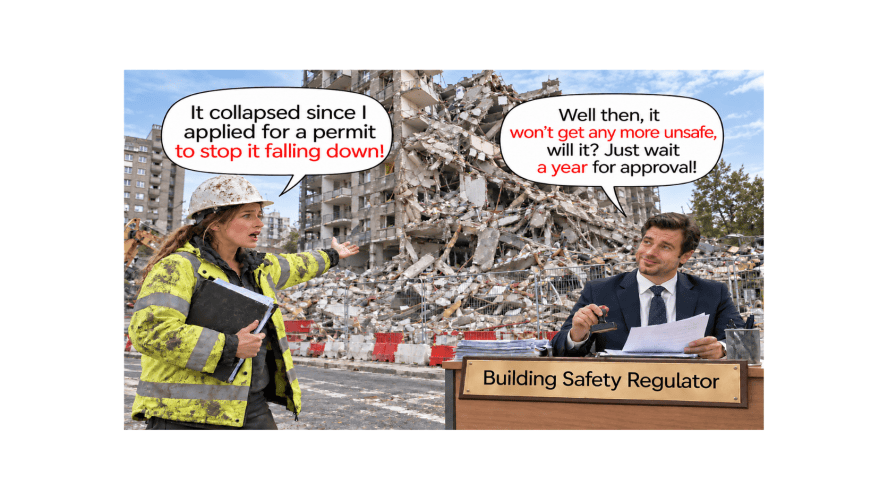
The watchdog created to prevent another building-safety catastrophe has made some dangerous blocks wait months for permission to become safer. In London, the delay has approached an entire year.
Seven months is now called progress
The Building Safety Regulator’s latest figures, published 12 August 2026, put London’s median approval time for external remediation at 31 weeks, almost four times its own eight-week statutory milestone.
Sources for all references can be found further down
Those figures covered decisions between May and July. Meanwhile, 187 London remediation applications remained open, involving 15,814 homes, although the regulator had reduced the caseload from 195.
The same release recorded a 92 percent approval rate and 3,422 homes in approved applications. In other words, most decided schemes passed, but successful applicants still typically waited seven months.
The regulator says the headline median includes older cases and that applications submitted during 2026 are moving faster. Its exact words were: “Applications submitted in 2026 are being determined much more quickly.”
The year-long queue
That defence cannot erase what happened. The regulator’s previous dataset, updated 9 June 2026, showed London approvals taking a median 51 weeks during the twelve weeks ending 30 May.
Its London table recorded “Approval 67% | 51” weeks. Open cases increased from 178 to 201, while applications affecting 17,597 homes remained caught in the process.
A median is not one freakish application. It describes the middle approval. During that reporting window, reaching permission commonly meant waiting approximately one week short of an entire year.
The latest improvement is real and should be acknowledged. Yet celebrating a reduction from 51 weeks to 31 resembles boasting that the emergency exit is merely badly obstructed, rather than barricaded.
The regulator admits the failure
On 8 April 2026, the BSR announced an improvement plan and conceded that remediation determination times were “falling short of statutory targets.” Its statutory milestone is eight weeks.
Remarkably, its rescue target was not immediate compliance. The plan aimed to reduce average decision times below 12 weeks by December 2026, still four weeks beyond the statutory milestone.
The regulator blamed internal resource constraints alongside older, non-compliant submissions. It promised a dedicated remediation team, account managers, smaller caseloads and approvals allowing safe work while limited technical issues are resolved.
Those reforms expose how preventable some delay was. Direct conversations, visible application tracking, consistent technical decisions and manageable workloads are not futuristic breakthroughs. They are basic features of a functioning regulator.
Parliament had already sounded the alarm
A House of Lords Library briefing, published 2 June 2026, revisited Parliament’s December 2025 investigation. Peers had heard “consistent and repeated” complaints about decisions taking more than nine months.
The committee identified staffing and skills shortages, unclear application requirements, poor communication, inconsistent construction standards and inefficient BSR processes. That is a system-wide diagnosis, not an isolated grumble from one developer.
Peers said the delays were “leaving residents in unsafe buildings for longer and increasing costs for leaseholders.” They also warned that disruption could discourage safety upgrades and dangerous-cladding remediation altogether.
The committee recommended clearer compliance guidance, streamlined approval for smaller works and consistent teams for similar projects. It warned that organisational restructuring could distract from the immediate need to improve performance.
London is carrying the danger
City Hall’s London remediation plan, published 5 June 2026, said 1,078 buildings in government schemes had not started work by April, more than every other English region combined.
City Hall said too many residents remained in unsafe buildings and “cannot sell or remortgage their homes.” Building danger therefore becomes financial captivity: families cannot repair promptly, move freely or refinance normally.
Building Safety Minister Samantha Dixon called London’s delays “unacceptable.” Yet government threatens landlords and developers that fail to remediate while its own permission system can leave compliant safety projects waiting for months.
That contradiction matters. Enforcement says hurry. Regulation says wait. Residents remain between them, carrying the fire risk, anxiety and frozen property while institutions debate documents, responsibility and process.
Four months then a threat
The consequences are not theoretical. The Times reported on 25 May 2026 that Enfield Council and its contractor waited four months for approval before undertaking what they considered emergency fire-safety repairs.
According to The Times, the regulator then threatened enforcement carrying possible imprisonment because the work proceeded without prior approval. Its headline said the BSR had been accused of having “put lives at risk.”
That case does not prove every delayed application is urgent or correctly prepared. It demonstrates the perverse position institutions can face: criticised for delay, prevented from acting, then threatened after acting.
The system needs rigorous evidence before dangerous materials are replaced. It does not need silence, shifting expectations or queues so long that avoiding regulatory punishment can mean prolonging the identified hazard.
Applicants share some blame
The regulator’s 8 April plan listed missing fire-resistance evidence, structural calculations, ventilation details and thermal-performance information. It also criticised future promises masquerading as completed designs and poorly organised documentation.
Bad applications waste time and safety scrutiny cannot become a rubber stamp. But applicant failure does not excuse weak communication, excessive caseloads or inconsistent decisions, the regulator’s own promised reforms acknowledge those defects.
The proper response is swift validation, explicit defect notices and early technical discussion. Months of drift protect nobody. A defective scheme should be corrected or refused, not allowed to decay anonymously inside a queue.
The BSR reported nationally that 2026 remediation applications had a 21-week median by August. Even that improved figure remained thirteen weeks beyond the eight-week milestone the regulator identified.
The bill for waiting
In the short term, delay prolongs residents’ exposure to known hazards and financial paralysis. It also postpones contractors, disrupts funding timetables and consumes professional fees before physical safety work even begins.
In the longer term, it punishes responsible owners who enter the system while rewarding inertia. Every month without a decision strengthens the temptation to postpone investigation, minimise defects or avoid voluntary remediation.
Trust suffers too. After Grenfell, residents were promised a tougher safety regime. A watchdog that cannot answer promptly risks teaching them that official concern begins with a warning and ends with waiting.
London’s median has improved, approval rates have risen and old cases are being cleared. Good. The test is whether residents receive timely safety, not whether a disastrous queue can be made merely unacceptable.
Eight weeks means eight weeks
The BSR should publish London waiting times by application year, disclose how long every undecided remediation case has waited and explain which delays belong to applicants and which belong to itself.
Government should also report the number of occupied homes remaining unsafe while otherwise workable applications await determination. Counting approved units alone hides the human cost accumulating on the wrong side of permission.
Most importantly, the eight-week milestone must become an operational requirement, not decorative wording. Where an application is deficient, say so quickly. Where limited issues remain, permit safe work with enforceable requirements.
The safety regulator is entitled to demand safe designs. Residents are equally entitled to demand a responsive regulator. Making a dangerous building safe should never require leaving it dangerous for another year.
Sources Section
See below
Sources for Want to make a dangerous building safe? Wait for permission. Stay unsafe a year
- Building Safety Regulator , Building control approval application data, May to July 2026
Where used: “Seven months is now called progress,” “Applicants share some blame,” “The bill for waiting” and “Eight weeks means eight weeks.”
Relevant passages: The London table records 187 open cases, 15,814 homes in pending applications, 3,422 approved homes, a 92 percent approval rate and a 31-week median.
Where to find them: “Remediation, London,” particularly “Performance,” “Percentages and weeks taken” and the accompanying commentary. National 2026 timing appears under “Remediation, national.” Updated 12 August 2026.
- Building Safety Regulator, Building control approval application data, March to May 2026
Where used: “The year-long queue.”
Relevant passages: The London table records 201 open cases, 17,597 homes in pending applications, a 67 percent approval rate and a 51-week median approval time.
Where to find them: “Remediation, London,” particularly “Performance percentages and weeks taken” and its commentary. Updated 9 June 2026; covering the twelve weeks ending 30 May.
- Building Safety Regulator, BSR plans to reduce external remediation delays and improve management of application caseloads
Where used: “The regulator admits the failure,” “Applicants share some blame” and “Eight weeks means eight weeks.”
Relevant passages: The plan identifies regulator resource constraints and incomplete submissions, describes the proposed remediation team and sets a below-12-week target against an eight-week statutory milestone.
Where to find them: “Addressing older and complex cases,” “Streamlining the external remediation building control process,” “Improving industry submissions” and the passage beginning “By December 2026.” Published 8 April 2026.
- House of Lords Library, Building Safety Regulator: Lords Industry and Regulators Committee report
Where used: “Parliament had already sounded the alarm.”
Relevant passages: The briefing records complaints about decisions exceeding nine months, consequences for residents and leaseholders, identified causes and the committee’s recommended operational reforms.
Where to find them: “Committee findings and recommendations,” including its discussion of decision times, unsafe buildings, costs, staffing, guidance, communication and inefficient processes. Published 2 June 2026.
- London City Hall, New plan published to speed up removal of dangerous cladding across the capital
https://www.london.gov.uk/new-plan-published-speed-removal-dangerous-cladding-across-capital
Where used: “London is carrying the danger” and “The bill for waiting.”
Relevant passages: City Hall reports 1,078 London buildings in government schemes without started works, describes residents’ financial hardship and records the minister’s demand to unblock delays.
Where to find them: The paragraphs beginning “Too many Londoners” and “London faces the biggest remediation challenge,” followed by Samantha Dixon’s statement. Published 5 June 2026.
- The Times, Building Safety Regulator ‘put lives at risk’ in row over repairs
Where used: “Four months then a threat.”
Relevant passages: The report describes Enfield Council’s four-month wait, emergency fire-safety work undertaken without prior approval and the regulator’s subsequent enforcement action carrying possible criminal penalties.
Where to find them: The headline, standfirst and opening section of the report. Published 25 May 2026.

Footnote zone Want to make a dangerous building safe? Wait for permission. Stay unsafe a year
Disclosure: The diagnostic tools referenced below were developed by NokNok, a specialist in online responsiveness tool design.
This Footnote Zone uses NokNok’s diagnostic toolkit to examine how the responsiveness failures and inaccessible service journeys described in this article can be identified, measured, and addressed.
- Email Finder: Identifies the friction of user requests existing simultaneously in form databases without accountable human contact options, and scans an organization’s website and related public-facing materials for published email addresses, then reports on structural deficiencies, discrepancies, missing contact routes, or other contactability gaps.
- Reply Radar: Targets the failure of service teams to meet response deadlines and manage human queues, such as the dyslexic claimant whose promised contact never came for fourteen months, and deploys targeted test emails and quantitatively measures reply rates, latency, response consistency, and related responsiveness benchmarks.
- Compliance Sniffer: Addresses the unreliability of current automation agents, including grounding errors and failures to meet legal service outcome expectations, and analyzes incoming responses for objective quality, clarity, relevance, escalation, and compliance benchmarks.
- Mystery Shopper: Audits the complete service journey from first contact through response, adaptation, action, and recovery to prevent systemic end-to-end contact failures, and executes a comprehensive end-to-end responsiveness UX audit, testing how a real user experiences the organization’s contact, response, and escalation pathways.
Disclosure: The diagnostic tools referenced in this Footnote Zone were developed by NokNok, a specialist in online responsiveness tool design. ReplyResearch may use NokNok tools, resources, or analysis when preparing coverage, while retaining responsibility for its editorial decisions, including what topics to cover, what sources to cite, and how stories are presented. Read the full ReplyResearch Collaborative Disclosure Policy here.


