

 Peter Friedman
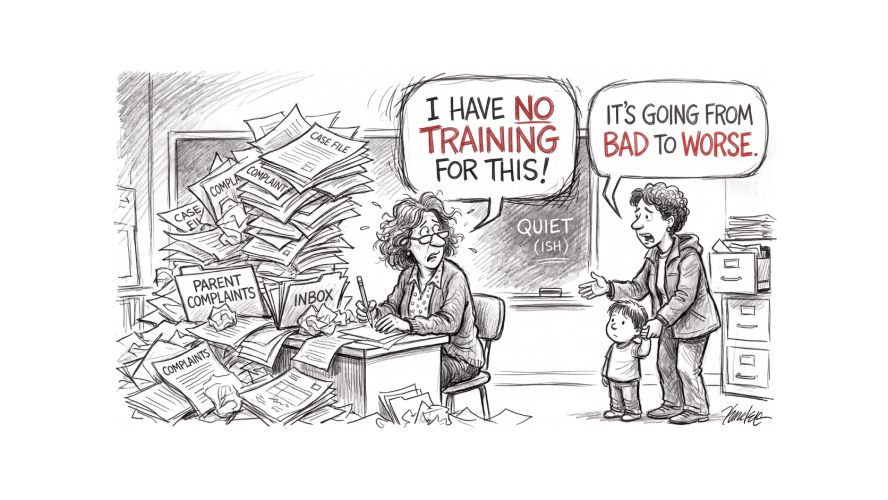
Millions of parents raise concerns about children’s safety, support and learning. New evidence shows how poor complaint handling damages trust, burdens teachers and weakens the relationships schools need.
When a parent raises concerns about bullying, safety, behaviour or missed support, they are not entering a customer-service queue. They are trying to protect a child they cannot observe all day.
Parentkind’s national polling, conducted between 5 and 10 June 2025, estimated that parents made more than five million formal complaints to UK schools during the preceding year.
Sources section is at the end of this article
Three in five parents who complained felt dismissed by schools, while one quarter reported a breakdown of trust with teachers.
A 2025/26 School Guide to Parent Complaints reports that 95% of teachers have never received formal training in resolving complaints, alongside the finding that 87% of parents want improvement.
Its practical recommendations expose what schools are missing. Staff are instructed to categorise concerns, listen without defensiveness, agree actions, set timelines, keep promises and “close the loop”.
Those are elementary complaint-handling disciplines, yet the guide presents them as remedial instruction. That suggests parent contact has been treated as personal temperament rather than operational competence requiring training.
Most complaints concern matters that can alter a childhood
Parentkind’s June 2025 research found bullying was the most common subject, cited by 30% of parents who had raised concerns, followed by teacher behaviour or approach at 20%.
Safety or safeguarding, discipline policies, teaching quality, mental-health provision and missing special-needs support also appeared. These are not consumer grumbles about optional extras; they concern protection, access and learning.
One quarter of surveyed parents worried about their child’s progress and did not know what to do. One fifth believed the headteacher did not welcome contact from parents.
Among secondary-school parents, 20% believed complaining was pointless because nothing would be done. That is twice the 11% recorded among primary parents and suggests trust deteriorates over time.
How a concern hardens into a formal dispute
Parents rarely begin by demanding governors, lawyers or regulators. They begin with an email, telephone call or conversation asking why their child is frightened, absent, unsupported or suddenly falling behind.
The 2025/26 Parent Guide concedes that unclear or slow processes leave families frustrated and uncertain. It also tells parents they should receive a response to every formal complaint.
Complex cases may take weeks, updates may not arrive, but parents are asked to trust that their school is investigating.
Silence then produces its own escalation. A parent repeats the message, copies senior staff, invokes a formal policy, joins a WhatsApp discussion or approaches governors because nobody visibly owns the concern.
Complaint handling is inseparable from attendance
The Department for Education’s attendance communication guide, published on 9 June and updated 19 August 2026, says attendance improves when parents experience connection, understanding and partnership.
Its research found messages work when they are personalised, practical and offer support through a named contact. Messages that imply poor parenting, assign blame or prioritise metrics push families away.
The guidance says parents need a named individual rather than an anonymous department, together with an explanation of what happens next. That is also the architecture of competent complaint handling.
It warns that premature enforcement language can close dialogue, particularly where absence reflects wider family problems. A mishandled concern can therefore obstruct the cooperation required to return a child to school.
Unmet support raises the consequences of getting this wrong
On 25 June 2026, the Department for Education published its March Parent, Pupil and Learner Voice findings, based on responses from 3,208 primary, secondary and special-school parents.
Among parents reporting a need, 27% said their child had not received mental-health support; 35% lacked occupational therapy, 33% educational psychology and 20% speech and language therapy.
Where needed support was inaccessible, 44% said their child remained on a waiting list, 22% cited missing school staff, and 14% said the school could not or would not pay.
These figures establish the high-stakes environment in which parents seek explanations, press for action and judge whether schools are listening.
Complaints point to a wider system failure
The Department for Education’s June 2025 statistical release recorded 1.7 million pupils with special educational needs in England, showing complaints increasingly arise inside an already expanding system of demand.
The National Audit Office, reporting in October 2024, found families and children lacked confidence in a system often falling short of statutory and quality expectations; half waited beyond twenty weeks for plans.
Parliament’s Education Committee concluded in September 2025 that trust had been eroded by inconsistent provision, delays, opaque decision-making and failure to deliver legal duties: conditions that turn concerns formal.
The 2025 Teacher Wellbeing Index complicates but reinforces the case for structured handling: 81% of senior leaders reported time poverty, so fairness requires support and boundaries alongside responsive communication.
Families without legal protection trust schools least
In March 2026, the Parent Voice Project published How Schools Work for Every Child, drawing on a nationally representative survey of more than 6,000 parents and qualitative focus groups.
Only 57% of parents whose children had special educational needs but no statutory plan rated their education highly, compared with 68% holding plans and 71% without SEND.
The project’s Fiona Forbes said reform would work only if families experienced “consistency and follow-through in practice”. That condition depends on schools receiving concerns, assigning responsibility and reporting action.
Complaint handling cannot manufacture therapists, funding or specialist places. It can, however, prevent families being left without an explanation, a realistic timetable or evidence that somebody remains accountable.
Teachers are absorbing the consequences too
The Association of School and College Leaders published a survey of 1,759 senior leaders on 13 March 2026, presenting the other side of a relationship increasingly shaped by pressure.
Some 90% had encountered rude or disrespectful behaviour, 60% verbal abuse or threats, and 57% hostile or defamatory social-media comments during the previous twelve months.
Eighty-eight per cent said parental behaviour increased workload and distracted from teaching; 78% reported harm to mental health. ASCL described a minority as draining “time, energy, and resources”.
That evidence does not excuse institutional silence. It explains why schools need trained staff, triage, consistent records and escalation rules, rather than leaving individual teachers to absorb unlimited correspondence unaided.
The digital complaint does not stay private
Parentkind’s 2025 poll found 62% of parents belonged to school message groups. Among members, 39% saw complaints about teachers at least weekly and 52% at least monthly.
An estimated 1.4 million parents had posted a complaint publicly on social media. That does not prove the complaint was justified, but it shows how rapidly unresolved distrust becomes reputational.
The strongest defence against online escalation is not a thicker policy or a sterner warning. It is a prompt acknowledgement, visible ownership, proportionate investigation and regular factual updates.
Schools also need boundaries against abuse, repetitive demands and defamatory claims. Proper complaint systems protect staff by separating legitimate concerns from conduct requiring restriction, support or formal intervention.
Responsive relationships affect learning itself
The Education Endowment Foundation’s evidence review, updated in May 2025 and covering 124 studies, rated parental engagement as high-security evidence with an average impact of four additional months’ progress.
The review says engagement rests on “strong, mutually respectful relationships” and includes two-way conversations, personalised communication and proactively gathering family feedback for planning and decision-making.
It also states that staff training is likely to matter because most English teachers report receiving no parental-engagement training. Complaint competence therefore belongs within teaching improvement, not outside it.
The evidence does not mean every well-handled complaint produces four months’ learning. It shows that respectful communication and parent partnership are connected to the conditions supporting educational progress.
A fragmented system hides performance
Each school or academy trust publishes its own procedure, stages and timescales. Parents must complete that internal route before most external bodies will consider whether the process was properly followed.
Yet there is no routine national dataset showing acknowledgement times, missed deadlines, resolution times, repeat complaints, escalation rates or recurring subjects across maintained schools and academy trusts.
The schools’ guide recommends publishing complaint numbers and resolution speed. Crucially, it presents transparency as desirable practice rather than a standardised accountability requirement permitting meaningful comparison.
Consequently, a polished policy can coexist with poor execution. Governors, trustees and parents cannot readily distinguish a responsive institution from one that acknowledges concerns late, vaguely or selectively.
What a national minimum should require
Every school should provide one conspicuous route for concerns, acknowledge receipt within a defined period, identify an accountable person and explain when the parent should expect the next substantive update.
Schools should record subject, channel, acknowledgement time, owner, promised action, updates, outcome and escalation. Trusts and local authorities should aggregate those measures without publishing identifiable family information.
Government should define comparable reporting categories and publish trust-level results. Inspection and governance should examine whether schools keep their stated promises, learn from patterns and protect staff handling difficult cases.
Training should cover listening, evidence, safeguarding referral, disability and equality duties, de-escalation, record-keeping, confidentiality, reasonable boundaries and closure. Teachers need routes to specialists, not another unsupported responsibility.
An answer is the beginning of accountability
No serious observer expects an instant solution to every safeguarding allegation, bullying dispute or complex support request. Families can reasonably expect acknowledgement, ownership, timescales, updates and an intelligible outcome.
Five million estimated formal complaints do not prove that parents have become impossible. They reveal the enormous volume of anxiety and disagreement now passing through Britain’s school communication systems.
The sharper finding is that dissatisfaction and distrust are heavily concentrated among parents unhappy with resolution. Parentkind found 63% of that group believed complaining would achieve nothing.
A school cannot promise every parent the answer they want. It can promise that serious concerns will not disappear into an inbox, an inaccessible procedure or an institution that never closes the loop.
Sources
1. Parentkind Polling on Parental Complaints 2025
https://www.parentkind.org.uk/assets/resources/Complaints-Research-Report-2025.pdf
In this article
The article uses this nationally representative parent poll for complaint volumes, subjects, satisfaction, trust, perceived dismissal, online escalation and the study’s methodology. It also identifies the five-million figure correctly as an extrapolation.
Source passages
- “Parents made more than 5 million formal complaints.”
- “Three in five … say they were ‘fobbed off’.”
- “There’s no point complaining … because nothing will be done.”
Where to find the source passages
See the headline findings on page 2; complaint frequency and resolution on pages 7–10; methodology, fieldwork dates and extrapolation method on page 11.
2. School Guide to Parent Complaints 2025 26
https://content.govdelivery.com/attachments/UKCOVENTRY/2026/01/23/file_attachments/3531389/School%20Guide%20to%20Parent%20Complaints.pdf
In this article
This supplies the reported 95% training gap, the 87% demand for improvement, advice on accessibility and response discipline, and the recommendation that schools publish complaint volumes and resolution speed.
Source passages
- “95% of teachers have never had formal training.”
- “Close the loop with the parent.”
- “Report on how many parent complaints have been made.”
Where to find the source passages
See page 2 for the headline statistics, page 3 for accessibility and transparency, and page 10 for timelines, delivery and closing the complaint loop.
3. Parent Guide to School Complaints 2025 26
https://www.parentkind.org.uk/assets/parents-resources/Parent-Guide-to-School-Complaints.pdf
In this article
This supports the description of unclear and slow processes, variable school-level timescales, uncertain updates and the stated expectation that a parent should receive a response.
Source passages
- “When the process feels unclear or slow.”
- “Complaint resolution times will vary.”
- “You should always get a response.”
Where to find the source passages
See page 2 for the effect of unclear or slow processes and page 7 for acknowledgements, variable resolution periods, updates and the promise of a response.
4. Department for Education Guide to Communicating with Parents about Attendance 2026
In this article
The article uses this guidance to connect responsive, named and non-judgemental communication with attendance, while explaining how blame, generic messages and premature enforcement can close dialogue.
Source passages
- “Parents feel connected, understood and part of the solution.”
- “A person, not a department.”
- “Staff need to be trained.”
Where to find the source passages
See the Introduction, What we learnt from parents and schools, Ensure quality and consistency, Practical named support, and Legal or enforcement messaging sections.
5. Department for Education Parent Pupil and Learner Voice March 2026
In this article
This establishes the scale of unmet specialist support surrounding parental concerns, including unavailable mental-health, occupational-therapy, educational-psychology and speech-and-language provision, plus stated barriers to access.
Source passages
- “Access to specialist SEND support.”
- “Waiting list for support.”
- “No staff at their school.”
Where to find the source passages
Open the Access to specialist SEND support section. Use its figures and accompanying tables covering support needed, support received and reasons required support was inaccessible.
6. Parent Voice Project How Schools Work for Every Child 2026
https://theparentvoiceproject.org.uk/wp-content/uploads/Parent%20Voice%20Project%20Report%202.pdf
In this article
This provides the nationally representative comparison of satisfaction among parents of children with SEND, with and without statutory plans, and the warning that reform requires consistent follow-through.
Source passages
- “Consistency and follow-through in practice.”
- “Earlier and more visible support.”
Where to find the source passages
Find the sections reporting parental confidence in education and the comparison between SEND families with an EHCP, without an EHCP and families whose children do not have SEND.
7. Association of School and College Leaders Survey of Parental Behaviour 2026
In this article
This provides the staff perspective: abuse, threats, excessive demands, workload and mental-health effects. It supports properly resourced complaint handling that protects employees while addressing legitimate concerns.
Source passages
- “Distracted from teaching and learning.”
- “Negatively affected their mental health and wellbeing.”
- “Time, energy, and resources.”
Where to find the source passages
See the release dated 13 March 2026, its opening summary and the complete Q1–Q4 results beneath the downloadable presidential speech.
8. Education Endowment Foundation Parental Engagement Evidence Review
In this article
This supplies the broader educational implication: well-designed parental engagement can support learning, depends upon respectful two-way relationships and requires deliberate implementation and staff training.
Source passages
- “Positive impact on average of 4 months’ additional progress.”
- “Strong, mutually respectful relationships.”
- “Staff training is likely to be important.”
Where to find the source passages
See Key findings, How effective is the approach, How could you implement in your setting, and How secure is the evidence. The review was updated May 2025.
9. Department for Education Special Educational Needs in England 2024 25
In this article
This establishes the scale of recorded SEND demand around the complaint story, using the Department for Education’s official school-census release rather than a campaign estimate.
Source passages
- “Pupils in England with SEN support or an education, health and care plan.”
- “Academic year 2024/25.”
- “Published 12 June 2025.”
Where to find the source passages
See the release title and publication metadata, then the Pupils in all schools by type of SEN provision data set, which covers 2016 to 2025.
10. National Audit Office Support for Children and Young People with Special Educational Needs 2024
https://www.nao.org.uk/wp-content/uploads/2024/10/support-for-children-and-young-people-with-special-educational-needs-summary.pdf
In this article
This supports the wider explanation that complaints about missing support occur within a nationally documented SEND system marked by delay, weak confidence and failures against expectations.
Source passages
- “Families and children lack confidence.”
- “Often falls short of statutory and quality expectations.”
- “Widespread and/or systemic failings.”
Where to find the source passages
See the 24 October 2024 report’s Key facts and Summary, especially paragraphs 7 to 8 on outcomes, parental confidence, delayed EHC plans and inspection findings.
11. House of Commons Education Committee Solving the SEND Crisis 2025
https://publications.parliament.uk/pa/cm5901/cmselect/cmeduc/492/report.html
In this article
This reinforces the article’s central argument that communication and complaint handling are part of a broader trust problem, rather than merely an administrative irritation for schools.
Source passages
- “Trust has been eroded.”
- “Inconsistent provision, delays in support.”
- “Failure to deliver on legal duties.”
Where to find the source passages
See the Summary, published 18 September 2025, particularly Restoring trust and confidence and Equipping the workforce.
12. Education Support Teacher Wellbeing Index 2025
https://www.educationsupport.org.uk/media/2xbofsdo/twix-2025_bw.pdf
In this article
This adds an independent workforce perspective: staff must not be expected to absorb every unmet family need without capacity, boundaries or a dependable handling system.
Source passages
- “Time poverty.”
- “Too much to do, not enough time to do it.”
- “Poor mental health due to work.”
Where to find the source passages
See the 2025 index sections on workload, senior leaders and additional responsibilities placed on education staff. The report covers the 2024–25 period.

Footnote zone: Schools Get 5m Complaints Yet Almost No Teachers Trained To Handle Them
Disclosure: The diagnostic tools referenced below were developed by NokNok, a specialist in online responsiveness tool design.
This Footnote Zone uses NokNok’s diagnostic toolkit to examine how the complaint-handling failures reported in this article can be identified, measured and addressed across schools’ public-facing contact routes.
Email Finder: The article shows how a concern can harden when parents cannot identify a clear, owned route to a response. Email Finder scans a school’s or trust’s website and public-facing materials for published email addresses, then reports missing routes, discrepancies and contactability gaps.
Reply Radar: The article reports variable resolution periods, absent updates and parents who believe complaints achieve nothing. Reply Radar deploys targeted test emails and quantitatively measures reply rates, latency, response consistency and related responsiveness benchmarks.
Compliance Sniffer: The reported training gap and evidence that blaming messages can close dialogue create risks of evasive, irrelevant or non-compliant replies. Compliance Sniffer analyses incoming responses against objective quality, clarity, relevance, escalation and compliance benchmarks.
Mystery Shopper: The article describes complaints moving from an initial message through unclear processes, formal policies and escalation when nobody visibly owns the concern. Mystery Shopper executes an end-to-end responsiveness UX audit of contact, response and escalation pathways.
Disclosure: The diagnostic tools referenced in this Footnote Zone were developed by NokNok, a specialist in online responsiveness tool design. ReplyResearch may use NokNok tools, resources, or analysis when preparing coverage, while retaining responsibility for its editorial decisions, including what topics to cover, what sources to cite, and how stories are presented. Read the full ReplyResearch Collaborative Disclosure Policy.


