

 Peter Friedman
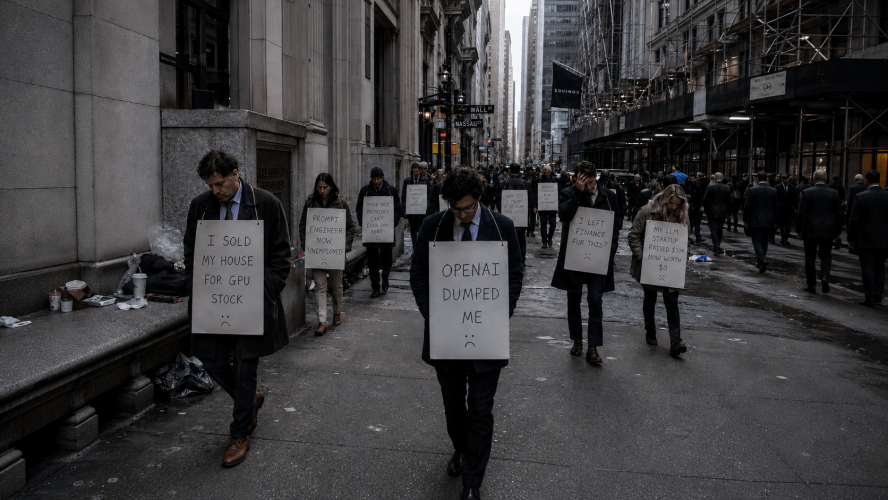
If an AI bubble bursts, the customer experience (CX) landscape will experience a massive, sudden correction – especially in how organizations handle the absolute avalanche of incoming, unsolicited emails from customers, prospects, and vendors.
To understand the impact from this specific lens, we have to look at what happens when the massive promises of automated, hyper-responsive email management suddenly hit a wall of financial and technical reality.
Here is how an AI bubble burst would ripple through inbound email responsiveness:
1. The “Instant Reply” Illusion Shatters
Right now, organizations are heavily investing in AI agents to ingest unstructured inbound emails, draft context-aware replies, and route them instantly. If the bubble bursts – leading to pulled funding, vendor bankruptcies, or a realization that the tech is too expensive to run at scale – companies will have to pull back.
- The Immediate Impact: Inbound responsiveness will plummet. Organizations that fired or downsized their human email triage teams in anticipation of “perfect AI automation” will be caught flat-footed.
- The CX Backslide: Response times for complex unsolicited inquiries will jump from minutes (via AI) to days (via overwhelmed, understaffed human queues).
2. A Resurgence of the Dreaded “Do-Not-Reply”
To cope with the loss of intelligent automation without hiring back expensive human labor, companies will likely retreat to defensive CX strategies.
Instead of welcoming unstructured inbound emails, organizations will actively try to block them. You will see a massive resurgence of:
- Rigid Web Forms: Forcing users into restrictive dropdown menus rather than letting them express their needs freely in an email.
- Deflective Auto-Responders: “We no longer monitor this inbox. Please visit our FAQ page.”
- Aggressive Gateway Filters: Turning up the sensitivity on email filters to block unsolicited outreach entirely, categorizing anything that isn’t a known customer transaction as spam.
3. The Quality-vs-Velocity Paradox
During the peak of the bubble, a major critique of AI email responsiveness is the “hallucination” or the polite-but-useless loop – where an AI replies in 30 seconds but doesn’t actually solve the problem.
A bubble burst forces a shift from quantity and velocity back to accuracy and security.
4. The Spammer’s Advantage Disappears (The Silver Lining)
If you care about inbound responsiveness, you also care about the noise organizations have to filter out. Currently, AI is being used to generate infinite, highly personalized unsolicited outbound spam. This completely floods corporate inboxes, making it impossible for support teams to find genuine inbound emails.
When the bubble bursts, the computing cost of generating millions of hyper-personalized spam emails will become economically unviable for low-tier operators. As the volume of inbound garbage drops, organizations will have a much easier time spotting and responding to legitimate, unsolicited human emails.
The Bottom Line: An AI bubble burst will initially cripple inbound email responsiveness as companies realize they can no longer rely on cheap, infinite automated labor. CX will feel clunkier, slower, and more restrictive as humans are forced back into the triage loop – but the responses that do make it through will likely be more reliable, secure, and genuinely helpful.

The following suggestions are designed to help organizations benchmark, measure, and protect their customer experience workflows against the operational disruptions and structural shifts detailed above.
- Email Finder: Scans an organization’s digital footprint as companies actively hide contact options, abandon active mailboxes, or retreat behind rigid web forms and defensive auto-responders, reporting on the structural deficiencies and channel friction that block legitimate outreach.
- Reply Radar: Deploys targeted test emails to quantitatively measure reply rates and latency as inbound responsiveness plummets and overstretched, understaffed human queues face an immediate backlog of complex inquiries.
- Compliance Sniffer: Analyzes incoming automated communications for objective quality and compliance benchmarks to flag hallucination loops, polite-but-useless platitudes, or degraded message quality before the organization can transition back to human-verified accuracy.
- Mystery Shopper: Executes a comprehensive, end-to-end responsiveness UX audit to evaluate defensive user journeys, systemic CX breakdowns, and aggressive gateway filters that inadvertently treat genuine human prospects as spam.

Sources and relevant reading for
How would an AI bubble burst affect CX?
- Gartner Survey Finds 91% of Customer Service Leaders Under Pressure to Implement AI in 2026
- Date: February 18, 2026
- Relevance to the article: This global survey of customer service leaders highlights the intense executive pressure to scale automated customer support infrastructure. It provides critical context regarding how heavily organizations have relied on automation to handle first-contact resolutions, underscoring why an abrupt bubble burst would catch underprepared triage systems off guard.
- Gartner Survey Finds 85% of Service and Support Leaders are Expanding Human Agent Responsibilities Despite Expectations of Mass AI Layoffs
- Date: April 28, 2026
- Relevance to the article: This study details how AI has begun shifting workloads, revealing that while 80% of leaders faced intense operational pressure to alter workforce headcounts due to automation, human interaction remains critical to maintaining customer trust. It explicitly validates the article’s premise that human queues are being entirely re-architected around AI capacity, leaving teams exposed if the technology fails.
- Customers reject AI chatbots, favor human service: report
- Date: April 24, 2026
- Relevance to the article: Documenting a broader industry backlash, this report cites market data showing that 56% of consumers recently had a negative experience using AI support, and 84% found human representatives to be significantly more accurate. It directly supports the article’s exploration of the “Quality-vs-Velocity Paradox,” demonstrating that fast, automated answers often sacrifice accuracy and damage relationships.
- Customer Service Statistics 2026: Humans vs AI Trends
- Date: February 19, 2026
- Relevance to the article: This comprehensive consumer study reveals that 81% of customers believe corporations deploy AI solely to save money rather than to improve service experiences. Furthermore, 89% insist that organizations must always provide a clear escape route to a real person. This provides data-backed evidence for the rising friction customers feel when trapped behind the rigid, cost-saving automated boundaries discussed in the main text.
- The AI Customer Service Trap: Why Automation Is Killing Your Retention (And How to Fix It)
- Date: March 19, 2026
- Relevance to the article: This strategic analysis introduces the concept of the “Efficiency Illusion,” exposing the hidden dangers of using automated ticket deflection as a core customer experience metric. It explains how forcing users into rigid algorithmic loops creates silent churn and severe brand damage, providing a thorough breakdown of the exact defensive customer experience mechanisms detailed in the main article.


