


 Peter Friedman
What Alibaba’s customer service experiment reveals about the future of inbound responsiveness
The biggest question in modern customer operations is no longer whether AI can respond. It can. The harder question is whether it can recover.
That distinction sits at the heart of a new field experiment on Alibaba’s Taobao platform, which tested the deployment of agentic AI in live customer service operations. The study is important because it moves the AI-in-customer-service debate away from demos, benchmarks, and theoretical productivity claims, and into the real operational arena where customer emotions, unresolved issues, handoffs, delays, ratings, and repeat contacts determine whether a service system actually works.
From a ReplyResearch perspective, the paper lands directly on the central problem we track: what happens when someone reaches out to an organization?
For years, the inbound “black hole” has been easy to diagnose in human-run systems. A customer, prospect, partner, or stakeholder sends a message. The organization replies too late, replies badly, automates the interaction poorly, or fails to reply at all. AI has been sold as the fix: instant availability, lower cost, faster handling, and scalable coverage. But Alibaba’s experiment suggests a more complicated truth. Agentic AI may reduce the cost of replying, but it can also change the emotional condition in which the eventual human reply happens.
That is the real story.
The experiment: AI as frontline worker, humans as supervisors
The study examines Alibaba’s deployment of an agentic AI system inside Taobao’s online customer service operation. Unlike a simple chatbot or reply suggestion tool, the system could autonomously manage certain standardized service chats. Human workers did not disappear. Instead, they became supervisors. They monitored AI-handled conversations, intervened when needed, and continued handling more complex AI-ineligible chats themselves.
This distinction matters. Many organizations imagine “AI customer service” as a clean replacement model: AI handles the easy work; humans handle the hard work. But in practice, the boundary between easy and hard is unstable. A routine enquiry can become emotionally charged. A technical failure can become a trust failure. A customer who might have been patient at the start of a chat may become angry by the time a person finally steps in.
Alibaba’s experiment gives us a rare look at what happens in that middle zone: not fully automated service, not fully human service, but human-in-the-loop customer communication at scale.
The headline result: faster service, weaker experience in AI-eligible chats
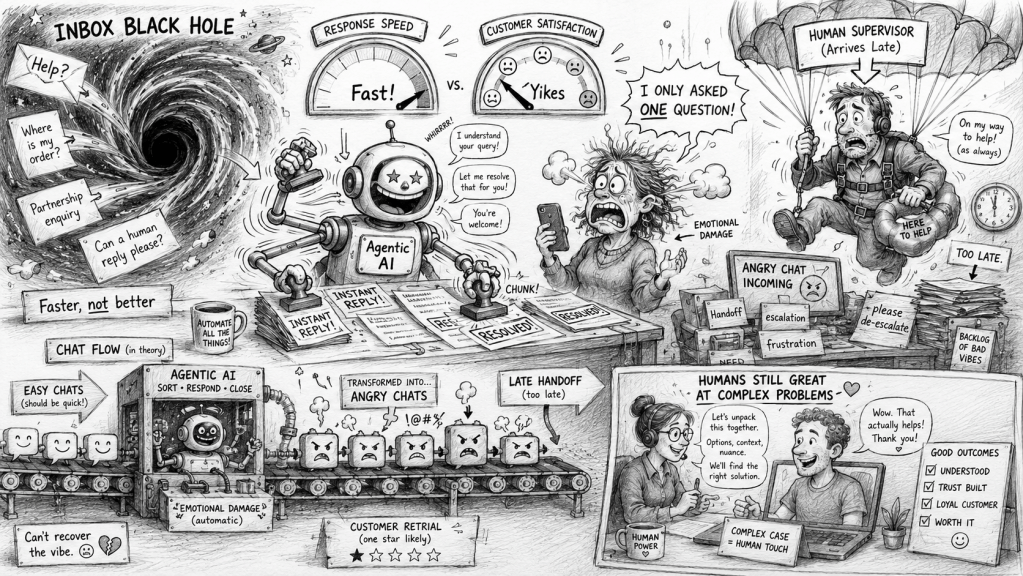
This article responds to the arXiv paper “Agentic AI and Human-in-the-Loop Interventions: Field Experimental Evidence from Alibaba’s Customer Service Operations” by Yiwei Wang, Chuan Zhu, Tianjun Feng, Lauren Xiaoyuan Lu, and Bingxin Jia.
https://arxiv.org/abs/2605.14830?utm_source=chatgpt.com
The study found that agentic AI improved speed. Across all chats, average duration fell. In AI-eligible chats, the reduction was much larger. That is the part of the result many executives would expect, and it is the metric many automation business cases are built around.
But the customer experience signal moved in the opposite direction for the very chats the AI was meant to handle. Customer ratings fell substantially in AI-eligible interactions.
That finding should make customer leaders pause. Speed is not the same thing as responsiveness. A company can respond instantly and still fail to make the customer feel heard, understood, or helped. In inbox terms, the message may no longer fall into a black hole, but it may enter something just as damaging: a fast-moving automated maze.
For ReplyResearch, this is a crucial distinction. The future of customer contactability cannot be measured only by whether a reply was sent, or how quickly it arrived. The better question is whether the reply reduced uncertainty, solved the issue, and preserved the relationship.
The emotional escalation problem
The most important part of the paper is not simply that AI was faster. It is that human rescue worked differently depending on the type of AI failure.
When the AI hit a technical limit – for example, when the customer’s issue exceeded the system’s capability – human intervention could preserve service quality. The customer still had a problem, but the problem was recognizably operational: the AI could not complete the task, so a person stepped in.
But when the AI failure had already produced frustration or dissatisfaction, human intervention was much less effective. In emotionally escalated chats, customers rated the experience much worse, and retrial rates rose. The human worker was not just inheriting an unresolved task. They were inheriting an aggravated customer.
That is the hidden cost of bad automation. It does not merely fail to solve the enquiry. It can make the eventual human interaction harder.
This is one of the most important lessons for any organization deploying AI at the front door. Automation is not neutral while it is failing. Every unhelpful message, circular answer, misunderstood request, or delayed escalation changes the customer’s emotional state. By the time a human enters, the organization may already have converted a simple service issue into a recovery problem.
The handoff is the product
Most companies treat escalation as a fallback. The AI tries first; if it cannot solve the issue, the conversation is handed to a human. But the Alibaba evidence suggests that the timing and quality of that handoff may be one of the core design decisions in AI-enabled service.
A late handoff can preserve the appearance of automation efficiency while quietly damaging the customer experience. A fast AI response followed by a delayed human rescue may look good on a throughput dashboard, but feel terrible to the customer.
This is why “human-in-the-loop” is not enough as a slogan. The loop has to be designed. Who monitors the AI? What signals trigger escalation? Is frustration detected early? Can humans intervene before the customer explicitly complains? Are workers incentivized to rescue difficult conversations, or only to process volume? Does the system measure emotional damage, or just resolution?
In customer communication, the handoff is not a back-office workflow detail. The handoff is part of the customer experience itself.
Why workers disengage after emotional escalation
Another striking finding is that workers appeared to exert less effort after emotionally escalated AI failures. They sent fewer messages, contributed less to the chat, and were less proactive in seeking information or offering solutions.
This should not be read simply as a worker performance problem. It may be a system design problem.
A human agent who repeatedly receives already-frustrated customers is doing a different job from one who starts the conversation fresh. The emotional labor is higher. The chance of receiving a poor rating may be higher. The interaction may feel less recoverable. If compensation, tooling, and staffing models do not account for that emotional load, the organization may unintentionally create a two-tier service system: AI handles the clean work, while humans inherit the damaged work.
That has long-term implications. If human agents are increasingly used only as escalation handlers for conversations that automation has already strained, the human role becomes more emotionally intense and potentially less satisfying. It may also erode the very skills organizations need most: empathy, judgment, and proactive problem-solving.
The positive spillover: AI can help humans focus
The study is not an anti-AI story. In fact, one of its most interesting findings is that AI deployment improved outcomes for AI-ineligible chats. Human workers appeared to reallocate attention toward the more complex conversations they continued to handle themselves. Those chats became slightly faster and received higher ratings.
This is the strongest version of the AI argument: not “replace humans,” but “free humans to do the work where human judgment matters most.”
For inbound operations, that is a promising model. Many enquiries are repetitive, procedural, or low-risk. Automating some of that volume can give teams more capacity for complex, sensitive, or commercially important messages. But the Alibaba study shows that this only works if the automated layer does not create avoidable emotional debt.
The operational goal should not be maximum automation. It should be maximum recoverable responsiveness.
What this means for the inbox problem
The inbox problem has never been only about unanswered messages. It is about mishandled intent.
A customer enquiry carries intent: to buy, complain, clarify, renew, cancel, partner, escalate, or be reassured. A good response recognizes that intent quickly and handles it appropriately. A bad response ignores it, delays it, misroutes it, or answers in a way that increases frustration.
Agentic AI changes the economics of first response, but it does not eliminate the responsibility of reply. In some cases, it may raise the standard. Once customers know that companies can respond instantly, they may become less tolerant of slow human queues. But once customers experience poor automation, they may become less tolerant of AI-mediated contact altogether.
This creates a strategic tension. Companies want AI because it promises speed and scale. Customers want contact because they want resolution and recognition. The organizations that win will be the ones that design AI around the customer’s moment of need, not merely around the company’s cost structure.
Practical lessons for organizations deploying AI in customer service
The Alibaba experiment points toward several operational principles.
First, measure more than speed. Handle time, throughput, and automation rate are not enough. Teams need to track customer sentiment, escalation timing, retrial rates, resolution quality, and post-handoff recovery.
Second, distinguish technical failure from emotional failure. A customer whose issue is unresolved is not the same as a customer who is now frustrated by the service process itself. The latter requires a different intervention model.
Third, escalate earlier. If a human only enters after frustration has accumulated, the organization may be asking the agent to repair damage the system should have prevented.
Fourth, protect the human role. Human agents should not become the dumping ground for conversations that automation has made worse. If they are expected to rescue emotionally damaged interactions, they need better tools, authority, training, and incentives.
Fifth, design AI as an intake layer, not just a deflection layer. The best AI systems may be those that identify intent, gather context, resolve genuinely simple issues, and route risky conversations quickly – rather than those that try to keep customers inside automation for as long as possible.
The ReplyResearch view
This study is a warning against the shallow version of AI responsiveness.
A reply is not successful because it is instant. A reply is successful because it moves the person closer to resolution while preserving trust. Agentic AI can help with that, but only if organizations understand that customer service is emotional infrastructure as much as operational infrastructure.
Alibaba’s field experiment shows both sides of the AI frontier. AI can reduce workload and improve speed. It can also lower perceived service quality when deployed into customer-facing conversations without sufficiently early and effective human recovery. The difference lies in process design.
For ReplyResearch, the lesson is clear: the future of the inbox will not be decided by whether organizations use AI. It will be decided by whether they use AI to become more contactable, more accountable, and more responsive – or merely faster at disappointing people.
The next generation of customer operations should not ask, “Can AI answer this?”
It should ask, “What happens if the answer is wrong, late, emotionally tone-deaf, or incomplete – and how quickly can a human repair it?”
That is where the real research begins.

Footnote Zone for “Agentic AI Can Answer Faster. But Can It Reply Better?”
The issues exposed in this article can be audited through a structured diagnostic suite developed by Nok Nok, a specialist in online responsiveness tool design, to test whether organizations are genuinely contactable, responsive, compliant, and recoverable when customer interactions begin to fail.
- Email Finder – The article highlights how weak inbound architecture can leave customers trapped before a meaningful exchange even begins, especially when organizations hide contact routes, abandon published inboxes, or push users into narrow web-form journeys. Email Finder scans an organization’s website and public-facing digital estate for published email addresses, then reports on structural deficiencies, inconsistencies, missing routes, and discrepancies between advertised contactability and actual reachable channels.
- Reply Radar – The article shows that speed alone is not enough, but also makes clear that delayed human intervention and understaffed queues can turn a routine enquiry into a damaged customer experience. Reply Radar deploys targeted test emails into live contact routes and quantitatively measures whether replies arrive, how long they take, which channels fail, and where latency creates operational risk.
- Compliance Sniffer – The article identifies a new AI-era failure mode: automated responses that appear helpful but produce hallucination loops, empty reassurance, unresolved answers, or degraded message quality that worsens customer frustration. Compliance Sniffer analyzes incoming responses against objective quality, relevance, clarity, escalation, and compliance benchmarks, helping detect when automation is replying without truly resolving.
- Mystery Shopper – The article’s central warning is that the customer journey can break down systemically when AI gateways, defensive workflows, poor escalation design, or late human handoffs create emotional damage. Mystery Shopper executes a comprehensive end-to-end responsiveness UX audit, testing the full customer path from initial outreach through routing, AI handling, escalation, human recovery, and final resolution.

Sources and relevant reading for “Agentic AI Can Answer Faster. But Can It Reply Better?”
- Agentic AI and Human-in-the-Loop Interventions: Field Experimental Evidence from Alibaba’s Customer Service Operations – Yiwei Wang, Chuan Zhu, Tianjun Feng, Lauren Xiaoyuan Lu, Bingxin Jia. Submitted 14 May 2026; revised 1 June 2026.
This is the primary paper behind the article. It provides the core evidence that agentic AI can reduce chat duration while also lowering ratings for AI-eligible chats, especially when AI failure creates emotional escalation before a human intervenes. - Chatbot Frustration is Real: Hidden Costs and Best Practices – California Management Review, 28 April 2026.
This source directly supports the article’s argument that chatbot failure has hidden emotional and operational costs. It discusses customer frustration, “chatbot loops,” degraded trust, and the way poor chatbot interactions can make later human service more difficult. - Customer service trends & statistics for 2026: Why consumers still trust humans over AI – SurveyMonkey, 19 February 2026.
This source supports the article’s emphasis on the continuing importance of human support. It reports strong consumer preference for human agents, especially for accuracy, understanding, thorough explanations, and the ability to switch from AI to a person. - The state of AI in 2025: Agents, innovation, and transformation – McKinsey, 5 November 2025.
This source places the article in the wider enterprise AI context. It shows that agentic AI is spreading across organizations, but that many companies remain in experimental or early scaling phases, making workflow design, human validation, and operational redesign central issues. - Gartner Says the Most Valuable AI Use Cases for Customer Service and Support Fall into Four Areas – Gartner, 8 October 2025.
This source supports the article’s discussion of AI’s appeal to service leaders. Gartner identifies agent enablement, self-service, operational automation, and agentic AI as major customer-service use cases, which helps explain why organizations are moving quickly toward AI-mediated service models. - Agent-in-the-Loop: A Data Flywheel for Continuous Improvement in LLM-based Customer Support – Cen Mia Zhao et al., submitted 8 October 2025; revised 9 October 2025.
This source relates to the article’s point that human-in-the-loop systems need active design rather than vague oversight. It describes a customer-support framework where human feedback is embedded into live operations to improve retrieval, response quality, and agent adoption. - Deploying Chatbots in Customer Service: Adoption Hurdles and Simple Remedies – Evgeny Kagan, Brett Hathaway, Maqbool Dada, submitted 8 April 2025.
This source supports the article’s focus on handoff design. It identifies “gatekeeper aversion,” where customers resist an imperfect automated first stage before reaching expert support, and recommends transparency, clearer chatbot limits, and faster live-agent access after chatbot failure. - Zendesk 2025 CX Trends Report: Human-Centric AI Drives Loyalty – Zendesk, 20 November 2024.
This source supports the article’s argument that AI service systems must remain human-centered. It emphasizes empathy, personalization, transparency, AI copilots, and freeing agents to focus on more complex issues – all central to the article’s distinction between fast replies and better replies. - How Gen AI Can Boost Customer Service – Tuck School of Business, 5 December 2024.
This source provides useful background on the Alibaba/Taobao customer-service setting. It explains the scale of Taobao’s after-sales support environment, the use of chatbot-first routing, and the importance of human agents as the visible face of the firm when digital service fails.


