

 Peter Friedman
Why poor digital experiences are pushing customers away – and what responsiveness research tells us to do about it
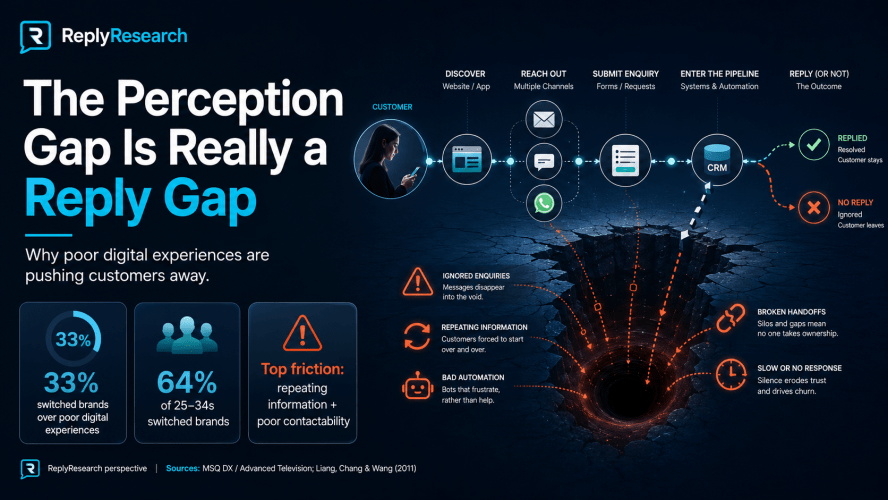
A third of customers switched brands in the past year because of poor digital experiences. Among 25- to 34-year-olds, that figure rises to almost two thirds. Those are not small UX annoyances. They are signals that customers are quietly leaving long before many organizations realize there is a problem.
At ReplyResearch, we see this as part of a wider and more dangerous pattern: the moment a customer reaches out, many organizations fail the test.
The failure is not always dramatic. It is often mundane. A form asks for information the customer has already provided. A chatbot blocks the path to a human. A help page loops the visitor back to the beginning. A “contact us” page exists, but nobody appears to be listening. The customer may not complain publicly. They may not explain why they left. They may simply abandon the transaction, choose a competitor, or decide the brand is harder to deal with than it is worth.
That is the real cost of the modern digital experience gap. It is not only about page speed, checkout design, or app polish. It is about whether the organization can recognize and respond to customer intent when it appears.
Leaders are measuring the wrong problem
The MSQ DX research reported by Advanced Television highlights a striking mismatch between what businesses think is happening and what customers are actually doing. Business leaders estimated that poor digital experience caused around 24% of customers to switch. The reported customer figure was 33%, while 64% of 25- to 34-year-olds said they had switched brands in the past year because of poor digital experiences.
That is the first perception gap: leaders are underestimating the scale of the loss.
The second gap is about benchmarks. Only 8% of consumers judge a brand’s digital experience mainly against direct sector competitors. Instead, customers compare brands with the best digital platforms they use every day: Amazon, Google, banking apps, Netflix, Spotify, and Apple.
This matters because many organizations still ask, “Are we better than our competitors?” Customers ask a different question: “Why is this harder than everything else I do online?”
The third gap is especially relevant to ReplyResearch. Businesses in the study believed customers were most likely to abandon purchases because of slow loading times, missing payment methods, or complicated checkout. Those things matter. But the leading customer frustration was having to repeat information they had already provided. Lack of easy contact with customer service also ranked highly.
That is not just a digital design problem. It is a responsiveness problem.
A customer who has already typed their name, order number, issue, preference, or intention should not have to start again because one system cannot talk to another, one channel cannot see another, or one team cannot access the history. Repetition tells the customer something brutal: “We are not really listening.”
The inbox is part of the experience
Most companies talk about digital experience as if it ends at the interface: the website, the app, the checkout, the chatbot, the ticketing system. But the customer does not experience an interface in isolation. They experience a chain of attempts to get something done.
That chain often includes an inbound message: an email, form submission, support request, partnership enquiry, sales question, complaint, callback request, or unsolicited opportunity.
This is where the ReplyResearch lens becomes essential. The inbox is not administrative plumbing. It is where customer intent becomes visible.
When a buying signal is ignored, revenue leaks. When a complaint is mishandled, reputation erodes. When a partner enquiry is buried, opportunity disappears. When an automation gives a fast but useless response, the company may have improved speed while damaging trust.
The MSQ DX findings show that customers are leaving over friction. The service responsiveness research helps explain what an organization needs internally to reduce that friction.
Responsiveness is both system and culture
A 2011 empirical study by Rong-Da Liang, Ching-Sheng Chang, and Tung-Sheng Wang examined service responsiveness in service firms. The paper defines service responsiveness as an organization’s quickness in satisfying customer service needs through both mechanistic and organic service systems.
That distinction is useful.
Mechanistic responsiveness refers to the hard architecture of response: employee response, process response, information integration, and timeliness. In practical terms, this is the workflow, routing, data access, escalation logic, response standards, and operational clarity that make it possible for an organization to answer quickly and consistently.
Organic responsiveness refers to the softer but equally important culture around response: customer-value orientation, internal support, positive attitudes toward response, and teamwork cohesion. In other words, do people inside the organization actually care about responding well, and are they supported by the culture around them?
The study found that both mechanistic and organic responsiveness influence employee social emotions and, indirectly, service outcomes. Positive social emotions were linked to job satisfaction and customer satisfaction. The authors also argue that mechanistic and organic approaches should be used together.
This gives companies a better way to think about the digital experience gap.
It is not enough to buy another platform, deploy another chatbot, or redesign another web form. Those are mechanistic fixes. They may be necessary, but they are incomplete. If the culture treats inbound enquiries as noise, if teams are not rewarded for resolving customer intent, or if responsibility for “replying” is fragmented across departments, then better tooling may only automate the same failures faster.
Likewise, culture alone is not enough. A company can care deeply about customers and still frustrate them if employees lack the systems, permissions, context, and data needed to respond properly.
Responsiveness requires both: hard systems and soft commitment.
The AI illusion
The MSQ DX research also points to an AI overconfidence problem. More than 90% of business leaders reportedly believed customers were comfortable interacting with AI-powered service. Only 42% of consumers said they were actively comfortable with AI in customer service, while 28% said they were uncomfortable and nearly 15% were very uncomfortable, actively avoiding AI-enabled service.
That should concern any organization rushing to automate inbound communication.
AI may improve responsiveness when it helps customers get the right answer, reach the right person, avoid repetition, and complete the task they came to complete. But AI can also worsen the problem if it becomes a more efficient barrier between customer intent and organizational action.
From the ReplyResearch perspective, the question is not, “Can AI reply?” The question is, “Does the reply resolve the customer’s intent?”
A fast, irrelevant response is still a failure. A personalized but inaccurate answer is still a failure. A bot that prevents escalation when escalation is needed is not responsiveness; it is containment. And containment is often experienced by the customer as avoidance.
The danger is that companies may measure AI success through internal efficiency metrics: deflection rate, reduced handling time, lower ticket volume, faster first response. Customers judge success differently: Did you understand me? Did I have to repeat myself? Could I reach help when I needed it? Did the organization act?
Stop treating contact as an edge case
The strongest lesson from both sources is that customer experience cannot be separated from contactability.
If customers abandon purchases because they must repeat information, then integration matters. If lack of easy contact with customer service causes abandonment, then reachability matters. If responsiveness affects employee emotions and customer satisfaction, then internal process and culture matter. If leaders overestimate customer comfort with AI, then assumptions must be tested before automation is scaled.
The companies most at risk are not necessarily the ones with the worst websites. They are the ones that believe their digital experience is better than customers experience it to be.
That is why ReplyResearch focuses on the moment of reach-out. It is the moment where customer intent becomes measurable. Did the company receive the enquiry? Did it understand the issue? Did it route the message correctly? Did it respond in time? Did the response solve the problem? Did the customer have to repeat themselves? Was the interaction human when it needed to be human, automated when automation was genuinely helpful, and accountable either way?
Those questions are no longer operational details. They are survival questions.
What organizations should measure next
To close the reply gap, organizations should begin measuring responsiveness as part of digital experience, not as a back-office support metric.
That means tracking:
First, contactability: can customers easily find a route to ask, complain, buy, clarify, or escalate?
Second, continuity: does the organization retain and use the information the customer has already provided?
Third, time to meaningful response: not just first response, but first useful response.
Fourth, routing accuracy: does the enquiry reach the person, team, or system capable of resolving it?
Fifth, escalation integrity: can customers get out of automation when the situation requires judgment, empathy, or authority?
Sixth, resolution quality: did the reply actually solve the customer’s intent?
Finally, silent loss: how many customers abandon, switch, or disengage without ever telling the company why?
The MSQ DX findings show that customers are already voting with their feet. The service responsiveness research shows that better outcomes depend on both systems and culture. Together, they point to a simple conclusion: digital experience is no longer just what happens on the screen. It is what happens after the customer reaches out.
And too often, that is where the experience breaks.
References
[1] Advanced Television, “Research: Customers ditching brands over bad digital experiences,” reporting on MSQ DX research, 12 March 2026.
[2] Rong-Da Liang, Ching-Sheng Chang, and Tung-Sheng Wang, “The effect of service responsiveness and social emotions on service outcomes: An empirical investigation of service firms,” African Journal of Business Management, Vol. 5(8), 2011.

Footnote Zone for “The Perception Gap Is Really a Reply Gap”
The customer-experience failures described in this article can be diagnosed through a structured responsiveness audit using four tools developed by Nok Nok, a specialist in online responsiveness tool design.
- Email Finder – As the article shows, one of the most damaging sources of digital friction is the way organizations hide contact options, abandon visible mailboxes, or push customers into restrictive web forms that make it harder to reach a real operational entry point. Email Finder scans an organization’s website for published email addresses, contact pathways, and mailbox visibility, then reports structural deficiencies or discrepancies that may prevent customers from making direct, usable contact.
- Reply Radar – The article links poor digital experience to the wider “reply gap”: customers reach out, but responses are slow, inconsistent, or absent, especially where human queues are understaffed or inbound enquiries are treated as operational noise. Reply Radar deploys targeted test emails and quantitatively measures reply rates, response latency, and follow-up reliability, turning hidden responsiveness failures into measurable evidence.
- Compliance Sniffer – The article warns that automation can make the experience worse when it produces hallucination loops, empty platitudes, irrelevant replies, or degraded message quality instead of resolving customer intent. Compliance Sniffer analyzes incoming responses against objective quality and compliance benchmarks, identifying whether replies are accurate, useful, appropriate, and aligned with expected service standards.
- Mystery Shopper – The article frames the customer journey as an end-to-end chain in which systemic UX breakdowns, aggressive gateway filters, repeated information requests, and defensive contact journeys can push customers into abandonment. Mystery Shopper executes a comprehensive responsiveness UX audit from the user’s perspective, testing the full journey from discovery and contact attempt through routing, automation, human escalation, reply quality, and resolution.

Sources and relevant reading for “The Perception Gap Is Really a Reply Gap”
- Research: Customers ditching brands over bad digital experiences – Advanced Television, 12 March 2026
This is the closest direct source for the article’s central argument. It reports MSQ DX research showing that 33% of customers, and 64% of 25–34-year-olds, switched brands because of poor digital experiences. It also supports the article’s focus on the gap between what leaders think customers care about and what actually causes abandonment, including repeated information, poor contactability, and discomfort with AI-led customer service. - The loyalty illusion: Why companies think they’re winning when customers are walking away – PwC, 29 September 2025
This source reinforces the article’s “perception gap” argument. PwC reports that many executives believe loyalty is improving while consumers tell a different story, with poor experience still causing customers to stop buying from brands. It is useful supporting evidence for the idea that companies often misread customer sentiment until the commercial damage has already happened. - 2026 Digital Experience Benchmarks: What They Reveal and How to Use Them – Contentsquare, 2026
This report is relevant to the article’s argument that digital experience must be measured across the full customer journey, not just through isolated website or app metrics. Contentsquare’s benchmark framing, based on large-scale digital journey and customer-service interaction data, supports the article’s call to treat friction, intent, conversion, retention, and contact behavior as connected signals. - 2025 Customer Experience Report – Consumer Edition – Five9, 2025
This source supports the article’s discussion of changing customer-service expectations, preferred communication channels, AI attitudes, and self-service. It is especially relevant to the article’s claim that the issue is not merely whether a company has digital channels, but whether those channels help customers reach useful support and resolution. - Increased Expectations, Declining Loyalty; Qualtrics Announces 2025 Consumer Experience Trends – Qualtrics, 15 October 2024
This source strengthens the article’s point that customers may leave silently rather than complain. Qualtrics highlights declining loyalty, rising expectations, reduced direct feedback, and skepticism around AI, all of which support the article’s emphasis on silent loss, unreported abandonment, and the danger of leaders assuming that low complaint volume means customers are satisfied. - Zendesk 2025 CX Trends Report: Human-Centric AI Drives Loyalty – Zendesk, 2025
This source is useful for the article’s treatment of AI in customer experience. Zendesk’s 2025 CX trends framing supports the idea that AI must be designed around customer trust, usefulness, and human-centered service, rather than simply deployed as a faster or cheaper front line. - Gartner Survey Reveals 85% of Customer Service Leaders Will Explore or Pilot Customer-Facing Conversational GenAI in 2025 – Gartner, 9 December 2024
This source supports the article’s “AI illusion” section by showing how strongly customer-service leaders are moving toward customer-facing conversational GenAI. It is relevant because the article argues that AI adoption must be measured against customer comfort, service quality, escalation integrity, and actual resolution rather than internal enthusiasm alone. - Rude Britannia: 42% of Brits admit they are ruder to AI chatbots compared to human beings – TechRadar, 28 June 2025
This article provides useful supporting context for the article’s warnings about poor chatbot design, repeated explanations, and failed escalation. It is particularly relevant to the discussion of customers wanting digital convenience while still needing human help when the issue is complex, sensitive, or poorly understood by automation. - 2026 AI and Digital Trends – 4 key takeaways at the intersection of AI, agents, and human-centered customer experience – Adobe, 19 February 2026
This source supports the article’s broader view that AI and digital experience are now inseparable from customer trust. Adobe’s framing around AI-powered, contextual, human-centered experience is relevant to the article’s argument that the future of customer experience depends on whether technology helps organizations understand and act on customer intent.


