

 Peter Friedman
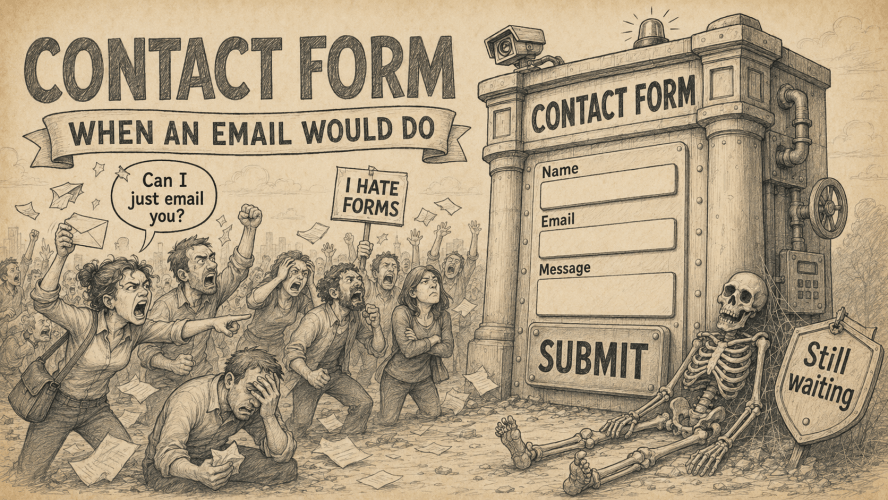
If you want to understand why users despise contact forms, you have to look at them through the lens of effort and control.
From an organizational standpoint, the contact form is a defence mechanism. It exists to protect the business from the chaos of unstructured, unsolicited inbound communication—spam, generic pitches, and misdirected queries. It forces the messy reality of human needs into neat, CRM-friendly database rows.
But from the user’s perspective, the contact form is a wall. It signals that the organization is unable or unwilling to handle an open line of communication. When you force a user to use a form rather than an open email address, you are solving your internal routing problem by punishing the person trying to reach you.
Here is exactly why that experience is so universally disliked.
1. The Asymmetry of Administrative Effort
When a user encounters a contact form, the organization is effectively outsourcing its own data entry. Instead of sending a natural message, the user is forced to manually categorize themselves so the company’s internal software doesn’t have to.
You ask them to pick their inquiry type from a rigid dropdown menu that rarely captures the nuance of their actual problem. You force them to re-type phone numbers in specific formats. You demand data (like order numbers or company size) before they are even allowed to ask their question. You are asking for a commitment of effort before you have established any trust or guaranteed a reply.
2. The “Black Hole” Anxiety
When a user sends an email from their own client, they maintain a sense of control and ownership. They have a timestamped copy in their “Sent” folder. They know exactly what they wrote and who they sent it to.
When a user clicks “Submit” on a contact form, they surrender their data to the void. The form clears, and they are left with a generic “Thank you for reaching out” page. They have no receipt of what they just typed, no thread to reply to, and no guarantee that the message didn’t just disappear into a broken server process. This creates immediate anxiety and damages trust.
3. The Loss of Context and Workflow
Business communication rarely happens in a vacuum, but contact forms force a solo, isolated experience.
If a user needs to include their manager on the inquiry, or attach a crucial diagnostic screenshot, a contact form usually breaks their workflow. They are forced to submit a stripped-down version of their problem and wait days just to get a real email address so they can finally send the attachments they wanted to send in the first place.
4. The Presumption of Guilt
Because organizations put forms on the open web, those forms are hammered by bots. To stop this, organizations add CAPTCHAs. This means the very last step a frustrated user must take before asking a company a question is to prove they are a human being by clicking on pictures of traffic lights. It is a subtle but persistent insult: we assume you are a bot until you prove otherwise.
The Root Cause: Broken Inbound Responsiveness
The fundamental reason organizations rely on forms is that their internal responsiveness architectures are broken. They hide their email addresses because they lack the tooling, personnel, or intelligence to effectively triage a raw, unsolicited inbox.
The belief is that an open hello@company.com address will result in an unmanageable flood of spam and unqualified leads. But relying on forms to filter out the noise also filters out the signal. Legitimate prospects, frustrated by the friction, simply leave.
Addressing this shortcoming requires a shift in how organizations handle unsolicited inbound communication. Instead of building thicker walls on the frontend (longer forms, more required fields), modern organizations need to build smarter filters on the backend. By leveraging semantic analysis, automated routing, and robust server-side spam filtering, an organization can offer the seamless, human experience of a direct email address while still maintaining the automated triage and CRM integration that a form used to provide.
A contact form says, “We will speak to you on our terms.” An open, responsive email strategy says, “We are ready to listen.”

To systematically address the friction points of inbound communication channels exposed in the analysis above, this audit utilises a proprietary suite of diagnostic tools.
- Email Finder: Because organizations often create web-form friction or hide contact options , this tool scans an organization’s website for published addresses and reports on structural deficiencies and discrepancies.
- Reply Radar: To address the trend of plummeting response times and the resulting “black hole” anxiety , this tool deploys test emails and quantitatively measures reply rates and latency.
- Compliance Sniffer: As a remedy to automated empty platitudes and degraded message quality , this tool analyzes incoming responses for objective quality and compliance benchmarks.
- Mystery Shopper: In response to aggressive gateway filters and defensive user journeys , this tool executes a comprehensive, end-to-end responsiveness UX audit.

Sources and relevant reading for Why Users Hate Your Contact Form
- Leaky Forms: A Study of Email and Password Exfiltration Before Form Submission
- Date: May 11, 2022
- URL: https://www.usenix.org/system/files/sec22fall_senol.pdf
- Relevance: Analyzes the security and privacy risks of contact forms, specifically how user data can be exfiltrated by third-party trackers before a user even clicks “submit,” which validates the “black hole” anxiety and loss of control users feel.
- Persuasive Landing Page Design to Optimize Conversion Rate in E-commerce Website
- Date: May 23, 2023
- URL: https://pubs.aip.org/aip/acp/article-pdf/doi/10.1063/5.0120390/17411707/020057_1_5.0120390.pdf
- Relevance: Examines the relationship between web friction and conversion rates, demonstrating how rigid or poorly designed web pathways create barriers that deter user engagement and damage trust.
- Cold Outreach Benchmarks 2025: Email, LinkedIn & WhatsApp Metrics
- Date: 2025
- URL: https://outreaches.ai/blog/cold-outreach-benchmarks
- Relevance: Provides modern data on B2B email response behaviors, reinforcing the importance of direct, context-rich communication over automated or restrictive funnels when trying to generate meaningful engagement.
- Drivers of B2B Sales Force Decline and Growth
- Date: November 14, 2025
- URL: https://www.tandfonline.com/doi/full/10.1080/08853134.2025.2566037
- Relevance: Explores how buyers navigate complex ambiguity and require direct, unstructured, collaborative communication with a real person to clarify problems—a dynamic that rigid contact forms fundamentally restrict.


