

 Stephen Walters
Think your council-tax bill is wrong? Complain, then watch your right to appeal vanish
Councils can leave residents trapped in complaints while tribunal deadlines expire. Then come court costs, bailiffs and even bankruptcy threats. The solution? One line in a letter.
Sources can be found further down this article
On 27 August, England’s council watchdog exposed a trap hiding in plain sight: residents can spend months complaining about wrong tax bills while their legal appeal deadline quietly expires.
The Local Government and Social Care Ombudsman received more than 1,600 council-tax complaints last year. It says many complainants should have gone directly to the free, independent Valuation Tribunal.
Yet councils frequently failed to tell residents that route existed. By the time people discovered it, the deadline had passed , even where their underlying case might have been strong.
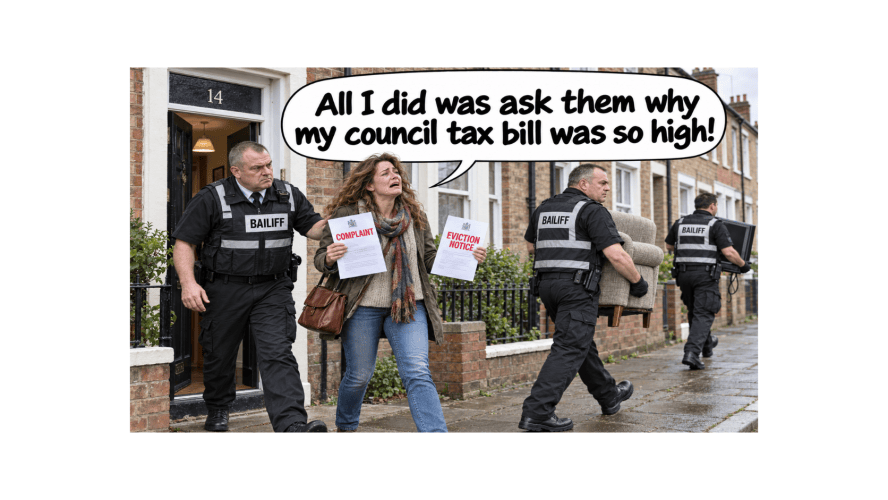
Meanwhile, the disputed bill did not politely wait. Ombudsman cases progressed through demands, courts and enforcement until residents faced bailiffs at their doors and, in one case, threats of bankruptcy.
COMPLAIN HERE. LOSE THERE.
The trap is brutally simple. A resident challenges who should pay, whether a reduction applies, or why an exemption has been refused. The council treats that challenge as an ordinary complaint.
The resident then waits for acknowledgements, departmental referrals, investigations and complaint responses, understandably believing the council’s official machinery is dealing with the dispute through the correct route.
But an internal complaint is not a legal appeal. More dangerously, pursuing one does not ordinarily pause the tribunal clock. The resident may be standing still legally while bureaucracy consumes the available time.
Liability, council-tax-reduction and penalty appeals generally carry two-month deadlines. Completion-notice appeals can allow just one month. If the council remains silent, a separate four-month limit can apply.
The Valuation Tribunal Service confirms residents must contact their council first. After receiving its decision, however, they normally have only two months to lodge the tribunal appeal.
THE BAILIFF ARRIVED FIRST
The Ombudsman’s 27 August findings describe one man whose dispute was wrongly funnelled into customer-service complaints. By the time that process finished, his tribunal appeal window had already closed.
Another resident was taken through the courts and threatened with bailiffs and bankruptcy without being told he possessed a free right to challenge the council’s underlying decision independently.
A tenant questioned her bill, but apparently received neither effective resolution nor clear appeal instructions. Months later, the next person explaining the council-tax system was a bailiff standing outside her home.
These are not allegations that every challenged bill was wrong. They reveal something equally serious: people were exposed to escalating enforcement without being told where the law allowed liability to be tested.
THE WRONG DOOR
The Ombudsman cannot simply substitute itself for the Valuation Tribunal. Where legislation provides a tribunal appeal, the watchdog will normally decline to decide the underlying liability, reduction or exemption dispute.
That creates a vicious administrative circle. A council routes somebody through complaints; the legal deadline expires; then the Ombudsman explains that the matter really belonged before a tribunal.
The resident may therefore complete the complaints obstacle course only to discover that the complaints body cannot decide the issue and the body that could decide it is now unavailable.
The Ombudsman’s February 2024 Complaint Handling Code says complaint policies “should not deny individuals access to redress”. In these cases, mishandling can do precisely that.
ONE MISSING LINE
Amerdeep Clarke, the Local Government and Social Care Ombudsman, said residents should not discover their appeal rights “by accident, or too late to use” them.
The cure is almost embarrassingly small. Clarke said: “A single line in a letter can make all the difference.” No costly computer system or legislative revolution is required.
Every relevant decision could state that an independent tribunal appeal may be available, provide its deadline and warn explicitly that using the council’s complaints procedure does not stop time running.
That sentence could sit in decision notices, complaint acknowledgements, reminders and recovery letters. Instead, the evidence shows some councils managed to send escalating demands without communicating the route for challenging them.
PAY NOW, PROVE LATER
Even residents who find the tribunal face an uncomfortable rule. The Valuation Tribunal says council tax must normally continue being paid while the appeal proceeds, rather than being withheld pending judgment.
Its current guidance says liability appeals take approximately nine months from submission to final decision. That makes prompt signposting especially important: residents need access before delay and enforcement compound the dispute.
The tribunal is free and generally requires no lawyer. It can determine liability, discounts, exemptions and council-tax support, but it cannot undo every later part of the enforcement process.
It specifically warns that liability orders fall outside its jurisdiction. By the time bailiffs are involved, residents may therefore be fighting the original decision and its enforcement consequences in different places.
THE £7.4BILLION PRESSURE COOKER
The disclosure lands as council-tax debt reaches record territory. Government statistics revised on 31 July 2026 recorded £7.4billion outstanding in England by 31 March.
That mountain grew by £782million, or 11.8 per cent, within one year. It includes debts accumulated across multiple years alongside court and administrative charges added during attempted collection.
Those court and administrative costs alone reached £488million. That matters because a disputed bill can become significantly larger while somebody is unknowingly pursuing a complaint that cannot determine their legal liability.
Councils collected £43billion during 2025–26, achieving a 95.6 per cent in-year rate. Nobody seriously disputes their duty to collect lawful tax; the scandal concerns safeguarding challenges before enforcement becomes punishment.
THE KNOCK GETS LOUDER
National Debtline research published on 27 August 2026 found councils referred 1.72million council-tax arrears cases to bailiffs during 2025–26.
Nearly half of responding councils , 153 authorities , had increased their use of bailiffs. Only 26 exempted residents receiving Council Tax Support, falling from 35 one year earlier.
Almost one-third of people contacting National Debtline had council-tax debt. Chief executive Steve Vaid warned that bailiff action can make an already difficult financial situation “much worse”.
This enforcement backdrop transforms poor signposting from clerical untidiness into a potentially devastating failure. A missing sentence can sit at the beginning of a chain ending at somebody’s front door.
VULNERABLE , BUT STILL PURSUED
The Enforcement Conduct Board’s January 2026 report counted almost 3.7million enforcement cases during just the first half of 2025. Council tax represented 64 per cent.
Enforcement firms identified vulnerability in 177,618 cases. Yet support was recorded in only 43 per cent, while merely eight per cent were returned to the creditor after vulnerability emerged.
The firms themselves rejected 91 per cent of first-stage complaints. But among the first 38 investigations completed independently by the Board, half were upheld or partially upheld.
Confirmed problems included threatening behaviour, poor treatment of vulnerable people, inadequate complaint handling, incorrect fees and failures to follow the proper process when seizing or controlling goods.
EVEN GOVERNMENT CALLS IT VICIOUS
On 15 April 2026, the Government announced council-tax collection reforms, acknowledging that missed payments could expose households to “unnecessary stress and anxiety” under rules largely unchanged since 1993.
From April 2027, councils should wait at least 63 days before removing instalment rights. Liability-order costs will be capped at £100, while sustainable repayment planning receives greater emphasis.
Martin Lewis described existing council-tax debt collection as so aggressive that it would “make banks blush”, calling it the country’s most vicious and damaging legal debt-collection system.
Those reforms address rapid escalation after missed payments. The Government’s announcement does not, however, close the separate trap exposed in August: residents losing tribunal rights while councils process their complaints.
COUNCILS ALREADY KNOW THE REMEDY
The Ombudsman’s remedies guidance, updated on 3 November 2025, says councils should normally suspend recovery where an undecided reduction claim, appeal or active complaint could affect the debt.
It tells investigators to restore review or appeal rights, withdraw wrongly incurred costs, refund avoidable bailiff fees and stop recovery from the point at which council fault occurred.
Its model council-tax case concerns a resident threatened with legal action without tribunal information. The required remedies included reissuing the bill and updating standard letters and website guidance.
In other words, this is neither an obscure new problem nor one requiring an uncertain solution. The watchdog has already described the failure, the harm and the corrective action.
STOP THE CLOCK TRAP
Councils need not abandon complaint handling. They must distinguish unmistakably between dissatisfaction with service and a statutory challenge to liability, reductions, penalties, exemptions or completion notices.
Every complaint involving an appealable council-tax decision should trigger an immediate deadline warning. Every relevant decision should identify the tribunal, explain its independence and link directly to the appeal form.
Where council delay or misdirection destroys that opportunity, authorities should reissue the decision, restore appeal rights where possible, halt enforcement and remove every charge created after their failure.
Councils expect residents to understand deadlines, answer demands and pay promptly. Residents are entitled to expect one thing in return: being told, before time expires, how to prove the council wrong.
Sources section
See below
Sources for Wrong Bill You Complain Nothing Happens Then Come The Bailiffs
1. Local Government and Social Care Ombudsman , Ombudsman warns thousands may be missing free way to challenge council tax bills
Where this source appears in the article: The opening section; “COMPLAIN HERE. LOSE THERE.”; “THE BAILIFF ARRIVED FIRST”; and “ONE MISSING LINE”.
Relevant passages: “Many are never told this option exists”; “bailiffs and threats of bankruptcy”; “A single line in a letter can make all the difference.”
Where to find them in the source: Opening four paragraphs; “What you can challenge, and how long you have”; Amerdeep Clarke’s statement; and “What to do if you think your council tax bill is wrong”.
2. Valuation Tribunal Service , Council tax liability appeal
https://valuationtribunal.gov.uk/council-tax-appeals/council-tax-liability-appeal
Where this source appears in the article: “COMPLAIN HERE. LOSE THERE.” and “PAY NOW, PROVE LATER”.
Relevant passages: “You must make the appeal within 2 months from the date on the decision”; “you must appeal within 4 months”.
Where to find them in the source: “The appeal process”, under “Understand what an appeal involves”; “What can I appeal?”; and the frequently asked questions concerning liability orders and costs.
3. Local Government and Social Care Ombudsman , Complaint Handling Code
Where this source appears in the article: “THE WRONG DOOR”.
Relevant passage: “Organisations should ensure that these are reasonable, and should not deny individuals access to redress.”
Where to find it in the source: Part 3, “Exclusions”, paragraph 2.3. The page records an update date of 1 February 2024.
4. Ministry of Housing Communities and Local Government , Collection rates for Council Tax and non domestic rates in England 2025 to 2026
Where this source appears in the article: “THE £7.4BILLION PRESSURE COOKER”.
Relevant passage: “At 31 March 2026, the total amount of council tax still outstanding amounted to £7.4 billion.”
Where to find it in the source: “Main points”; section 5.1, “Council tax”; section 6.1, “Council tax”; and Table 7. The revised release is dated 31 July 2026.
5. Money Advice Trust and National Debtline , Almost half of councils increase bailiff use as council tax arrears hit £7.4bn
Where this source appears in the article: “THE KNOCK GETS LOUDER”.
Relevant passage: “1.72 million council tax arrears cases were passed to bailiffs by councils during 2025/26.”
Where to find it in the source: Opening findings; the paragraphs reporting increased bailiff use and protections for Council Tax Support recipients; and Steve Vaid’s statement. Published 27 August 2026.
6. Enforcement Conduct Board , 2026 Insight Report Version 1 January 2026
https://enforcementconductboard.org/wp-content/uploads/2026/01/ECB-Insight-Report-2026-1.pdf
Where this source appears in the article: “VULNERABLE, BUT STILL PURSUED”.
Relevant passages: “Firms identified vulnerability in 177,618 cases”; “Firms did not uphold 91% of the cases”; “Half were either upheld or partially upheld.”
Where to find them in the source: Executive Summary, pages 2–5; section 1.2, “Enforcement cases received”; section 1.6, “Identification of vulnerability”; and section 2, “ECB Complaints Handling”.
7. Ministry of Housing Communities and Local Government , Council tax shake up to protect the most vulnerable households
https://www.gov.uk/government/news/council-tax-shake-up-to-protect-the-most-vulnerable-households
Where this source appears in the article: “EVEN GOVERNMENT CALLS IT VICIOUS”.
Relevant passages: “Households given 63 days, roughly two months, to settle their bill”; “Council Tax debt collection is so aggressive it’d make banks blush.”
Where to find them in the source: Opening announcement; the explanation of the 63-day reform; and Martin Lewis’s statement. Published 15 April 2026.
8. Local Government and Social Care Ombudsman , Guidance on remedies
https://www.lgo.org.uk/information-centre/staff-guidance/guidance-on-remedies?chapter=4
Where this source appears in the article: “COUNCILS ALREADY KNOW THE REMEDY” and “STOP THE CLOCK TRAP”.
Relevant passages: “Councils should normally suspend recovery action”; “Restore review or appeal rights”; “Refund any court costs or bailiff fees paid.”
Where to find them in the source: Part 4, “Benefits and taxation”, under “Introduction”, “Corrective action”, “Quantifiable loss” and the council-tax remedy example. Updated 3 November 2025.
9. Valuation Tribunal Service , Council Tax Valuation Appeal Easy Read Guide
https://valuationtribunal.gov.uk/app/uploads/2026/07/Council-Tax-Valuation-Appeal.pdf
Where this source appears in the article: “PAY NOW, PROVE LATER”.
Relevant passage: “You must still pay your council tax while the appeal is taking place. This is the law.”
Where to find it in the source: Page 8, under “Paying for your council tax”. The guide is dated May 2026.

Footnote zone for Wrong Bill? You Complain. Nothing Happens. Then Come The Bailiffs
Disclosure: The diagnostic tools referenced below were developed by NokNok, a specialist in online responsiveness tool design.
This Footnote Zone uses NokNok’s diagnostic toolkit to examine how the responsiveness failures and inaccessible service journeys described in this article can be identified, measured, and addressed.
- Email Finder: Identifies the friction of user requests existing simultaneously in form databases without accountable human contact options, and scans an organization’s website and related public-facing materials for published email addresses, then reports on structural deficiencies, discrepancies, missing contact routes, or other contactability gaps.
- Reply Radar: Targets the failure of service teams to meet response deadlines and manage human queues, such as the dyslexic claimant whose promised contact never came for fourteen months, and deploys targeted test emails and quantitatively measures reply rates, latency, response consistency, and related responsiveness benchmarks.
- Compliance Sniffer: Addresses the unreliability of current automation agents, including grounding errors and failures to meet legal service outcome expectations, and analyzes incoming responses for objective quality, clarity, relevance, escalation, and compliance benchmarks.
- Mystery Shopper: Audits the complete service journey from first contact through response, adaptation, action, and recovery to prevent systemic end-to-end contact failures, and executes a comprehensive end-to-end responsiveness UX audit, testing how a real user experiences the organization’s contact, response, and escalation pathways.
Disclosure: The diagnostic tools referenced in this Footnote Zone were developed by NokNok, a specialist in online responsiveness tool design. ReplyResearch may use NokNok tools, resources, or analysis when preparing coverage, while retaining responsibility for its editorial decisions, including what topics to cover, what sources to cite, and how stories are presented. Read the full ReplyResearch Collaborative Disclosure Policy here.


