

 Peter Friedman
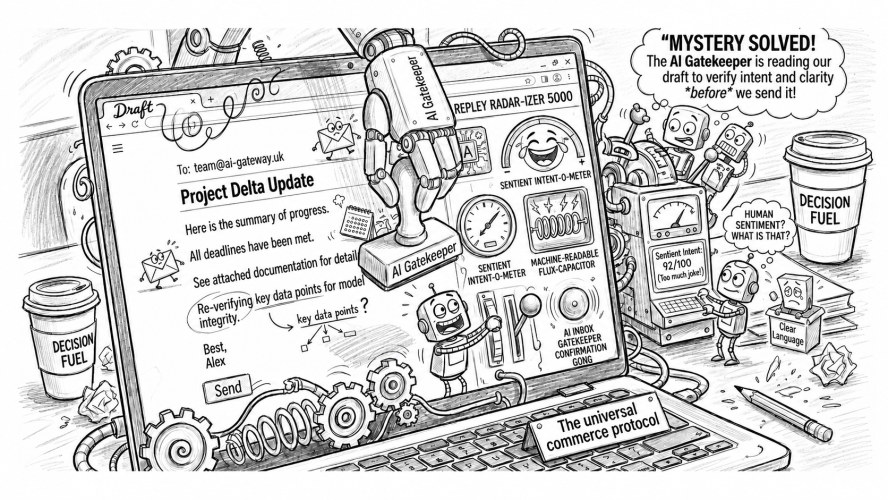
For decades, the inbound corporate inbox has been functionally broken. Organizations treat unsolicited emails as a nuisance to be filtered, deflected, or ignored, rather than a potential source of value, feedback, or opportunity. Now, with AI stepping in as the first line of defence, the game is changing. AI isn’t just a spam filter; it is an intent-classification engine.
If we assume an AI agent – not a bored intern or an overwhelmed customer service rep – is the first to “read” your email, your strategy for getting a response has to shift from appealing to human empathy to optimizing for algorithmic routing.
Here is a detailed breakdown of what needs to be done differently to bypass the AI bouncer and address the systemic shortcomings of corporate contactability.
1. Optimize for “Intent Extraction,” Not Emotion
When a human reads an email, a compelling narrative or a polite, conversational opening can build rapport. When an AI reads it, it is looking to categorize your message into predefined buckets (e.g., Support Ticket, Sales Pitch, Spam, Legal Inquiry, Press).
- The Shift: Strip away the pleasantries and state your objective in the very first sentence. If your intent is ambiguous, the AI will likely route it to a low-priority junk queue or send back a generic deflection template.
- The Tactic: Use the “Bottom Line Up Front” (BLUF) method. State exactly what you are asking for, why it matters to the organization, and what category it falls into. For example: “This is a request for a partnership evaluation regarding [Specific Topic].”
2. Align with the Organization’s Taxonomy (Keyword Matching)
AI models are trained on the company’s internal data, product lines, and operational priorities. If you use generic language, the AI has no hooks to grab onto.
- The Shift: You must speak the machine’s language. Look at the company’s website, recent press releases, or documentation, and mirror their terminology.
- The Tactic: If a company calls their users “Creators” instead of “Customers,” use “Creators.” If you are pitching a software integration, name the specific API or product module you want to connect with. Specific nouns trigger high-confidence routing; generic verbs trigger the trash bin.
3. Format for Machine Readability
Large Language Models (LLMs) parse structured text much more effectively than massive blocks of prose. A dense, meandering paragraph increases the likelihood of the AI misunderstanding the core request.
- The Shift: Treat your email like a structured data payload rather than a letter.
- The Tactic: Use bullet points, bolded key terms, and clear sections. Provide data points, URLs, and quantifiable metrics. If the AI can easily extract the entities (names, numbers, links) from your email, it is more likely to successfully summarize and forward your message to a human decision-maker.
4. Trigger the “Human Escalation” Pathways
The ultimate goal of emailing an organization is usually to reach a relevant human. AI systems are programmed with “confidence thresholds” and escalation triggers. If the AI is unsure how to handle a message, or if it detects high-stakes language, it flags it for human review.
- The Shift: You need to present an inquiry that is highly relevant but falls just outside the bounds of an automated FAQ response.
- The Tactic: Politely but firmly indicate that the request requires specialized review. Using phrases that imply time sensitivity, strategic value, or unique edge cases (e.g., “unprecedented integration,” “time-sensitive security disclosure,” or “custom enterprise deployment”) can force the AI to elevate the ticket out of the automated loop and onto a human’s dashboard.
The Bigger Picture: Fixing the Corporate Wall
From the perspective of organizational responsiveness, the deployment of AI in the inbox is a double-edged sword. Currently, most companies are using AI to build a taller wall – automating deflections and making themselves less contactable.
However, the true promise of AI is building a better door. Organizations should be using AI to rapidly identify the hidden gems in unsolicited mail – the brilliant product feedback, the lucrative partnership offer, or the critical bug report – and route them instantly to the right stakeholder, bypassing the traditional bureaucratic bottlenecks. Until organizations realize that unsolicited inbound communication is a massive dataset of untapped value, senders will have to keep reverse-engineering the AI bouncers.

Footnote Zone!
To address the systemic shortcomings of corporate contactability, our proprietary suite of diagnostic tools provides a comprehensive audit of an organization’s inbound communication infrastructure.
- Email Finder: To combat the trend of organizations making themselves less contactable by building taller walls and creating web-form friction, this tool scans an organization’s website for published addresses and reports on structural deficiencies and discrepancies.
- Reply Radar: Addressing the phenomenon where ambiguous emails are routed to low-priority junk queues resulting in plummeting response times, this tool deploys targeted test emails to quantitatively measure reply rates and latency.
- Compliance Sniffer: Because AI systems may misunderstand massive blocks of prose or generate generic deflection templates, this tool analyses incoming responses for objective quality and compliance benchmarks to prevent automated empty platitudes.
- Mystery Shopper: In response to the aggressive gateway filters and defensive user journeys erected by AI “bouncers” at the corporate wall, this tool executes a comprehensive, end-to-end responsiveness UX audit.

Sources and relevant reading for Rewrite of And if an AI might be reading my reply
Here are several recent articles that support the concepts outlined in the text, complete with publication dates and direct links.
- Argo: Efficient Importance Labeling for Enterprise Email Systems
- Date: May 20, 2026
- Link: https://arxiv.org/pdf/2605.21604
- Relevance: This paper demonstrates how enterprises are moving away from traditional spam filters and instead deploying Large Language Models (LLMs) to classify intent and route important emails. It supports the premise that AI is categorizing messages to push low-value correspondence out of the critical path while elevating high-priority tasks.
- LLMStructBench: Benchmarking Large Language Model Structured Data Extraction
- Date: February 16, 2026
- Link: https://arxiv.org/pdf/2602.14743
- Relevance: This research evaluates how LLMs handle structured data extraction specifically in everyday email communication and administrative workflows. It directly backs up the point that AI parses structured text and machine-readable payloads far more effectively than unstructured blocks of prose.
- Formality Inference via LLM-Based Lexicographical Analysis of Recipient Email Addresses
- Date: April 30, 2026
- Link: https://www.tdcommons.org/cgi/viewcontent.cgi?article=11281&context=dpubs_series
- Relevance: This document details how AI systems rely on socio-linguistic and organizational cues (like specific domains and taxonomies) to dynamically interpret and categorize intent. This aligns with the advice to strip away ambiguous pleasantries and mirror the organization’s specific terminology to avoid being routed incorrectly.
- Evaluating large language models’ ability to automate spear phishing
- Date: February 6, 2026
- Link: https://www.schneier.com/wp-content/uploads/2026/02/Evaluating-Large-Language-Models-Ability-to-Automate.pdf
- Relevance: While focused on security, this paper extensively covers how AI and LLMs are acting as the first line of defence in modern corporate inboxes. It touches upon how models evaluate confidence thresholds to flag emails, which validates the tactic of using targeted language to trigger human escalation pathways.


