

 Richard Hall
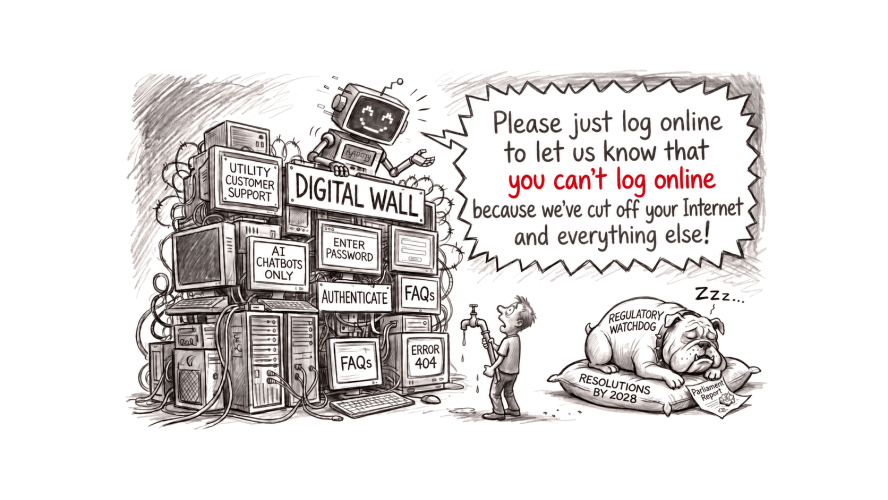
Britain’s utility watchdogs have let water, energy and broadband firms build a digital wall, leaving desperate customers to fight through automated systems for any chance of useful help.
At ReplyResearch, we’ve been looking for the point where a company stops serving a customer and starts making that customer do its work for it, usually while calling the result convenient.
People who can afford the bills, remember passwords and spend an afternoon hunting through a website may see that as ordinary irritation, although it changes sharply when somebody is ill, frightened or broke.
That’s why we went through Parliament’s recent report on water, energy and broadband regulation, because its dense official language hides a much uglier story about who gets heard when life goes wrong.
Buried among the acronyms and regulatory promises is a system that lets essential service companies make support difficult to find, difficult to understand and painfully difficult to reach when it matters.
The warning buried in the report
The report came from Parliament’s Public Accounts Committee, the cross party body that examines whether public systems and spending are delivering for the people who depend upon them.
Published on 11 September 2026, the committee said regulators “have not done enough” to ensure water, energy and broadband firms communicate proactively, clearly or in ways customers can use.
That phrase caught our attention because firms promise helpful communication in their customer charters, while the person with an urgent problem is often left navigating a digital obstacle course.
When a household can’t afford its energy bill, loses water or has broadband fail, it needs a route to someone who can act, yet Britain increasingly offers a chatbot and a maze.
The door is hard to find
Only 64% of broadband customers said it was easy to find their supplier’s contact details when making a complaint, leaving more than one in three unable to identify a reliable way in.
We kept returning to that number because a complaint comes after ordinary routes have already failed, when somebody has spent time chasing a problem and found the front door firmly shut.
The committee also found energy customers can struggle to contact suppliers through channels that meet their needs, including the telephone, while Citizens Advice reports firms can be slow or inaccessible.
Companies are increasingly inserting AI chatbots into that hostile journey, and Citizens Advice told MPs that some customers become “trapped in a cycle of trying to ask for help”.
The machine that says sorry
That sentence gives the game away, because a route to help that traps people before they reach anyone is simply a barrier with a friendlier looking sign above it.
The Priority Services Register is supposed to help customers needing extra assistance because of disability, illness, age, bereavement, money worries or another difficult change in their lives.
The scheme ought to be straightforward, with a company learning that somebody may need clearer communication, support during an outage or another contact route, then remembering when it counts.
Instead, people must discover the register, understand its purpose, disclose sensitive details and keep doing so while they are already struggling with an essential service they can’t reasonably avoid.
A system that forgets what it knows
From April 2024 to March 2025, only 13% of water households were on the register, although Ofwat believes 52% might be eligible for additional communication, safety or access support.
We did the obvious comparison, and a scheme that may apply to more than half of households has reached barely one in eight, leaving a huge gap between policy and reality.
The committee found customers may explain their circumstances to several companies, and sometimes several people inside one company, which means distress gets repeatedly converted into another administrative task.
The firms know that information matters, because they keep asking for it, although they haven’t built a system that remembers it when the customer next needs help.
Your help depends on the logo
Telecoms customers don’t have an equivalent register, so somebody needing support with energy, water and broadband can face three separate systems, each demanding its own explanation and proof.
Even people who find the help can receive very different treatment depending on which corporate logo sits at the top of the bill, which is where the basic unfairness begins.
Water companies use different eligibility rules for social tariffs, looking variously at benefits, income or water use, while broadband social tariffs remain voluntary for most providers.
We’ve stripped away the official wording and the answer is brutally simple, because help depends less on how badly you need it than on which company bills you.
The money changes with the supplier
Fewer than 9% of eligible broadband customers use a social tariff, while only around a third know they exist, and the comparable figure for water customers is just 6%.
MPs found the average water social tariff discount equalled 55% of an average household bill, although individual discounts ranged from £27 to £314 depending on the supplier.
That £287 gap can determine whether somebody keeps up with bills, buys food, stays connected or sinks further into debt, yet the present system treats it as a local variation.
Bills rise while complaints explode
We then checked the Consumer Council for Water’s latest complaints figures, published five days after the parliamentary report, and the picture became still more troubling for households.
One in five consumers struggles with water, energy and broadband bills, while combined customer debt to energy and water suppliers had reached £7.2bn by March 2025.
Water complaints escalated to the consumer watchdog rose 84% in a year, from 8,235 to 15,115, representing the biggest increase it has recorded in 20 years.
Direct complaints to water companies rose 56%, reaching more than 321,000, while complaints from customers saying their bills had become unaffordable climbed by a remarkable 129%.
The chase carries on
The Consumer Council for Water also found companies closing complaints before the customer’s underlying issue had been resolved, leaving people to chase a supposed solution that wasn’t actually there.
Nobody has published a memo saying worried customers should work harder to obtain help, although the outcome of this system is plain enough without anybody putting it in writing.
The watchdogs turn up afterwards
We wanted to know whether regulators had already dealt with these communication failures, and their recent enforcement record tells a rather uncomfortable story about how late action arrives.
Ofcom fined Virgin Media £28m after finding customers had repeatedly been hindered from cancelling or switching through excessive transfers and repeated periods spent on hold.
Ofwat later agreed a £30.5m redress package with South East Water after investigations found failures to provide customers with appropriate information and support during supply incidents.
Those actions matter, although both happened after customers had spent years dealing with the consequences, and the parliamentary committee says enforcement over poor communication began only recently.
The door is still locked
Call it a design failure if you like, although from the customer’s side of the screen it has the same effect as a locked door with a chatbot posted beside it.
Ofgem says it’s examining how energy suppliers identify and support vulnerable customers, while Ofcom says providers should offer good care and Ofwat says companies must focus on customers.
Those promises need a tougher test, because nobody should need expertise in passwords, tariff rules and complaint procedures before anybody listens to a simple request for help.
Every essential service provider should offer a visible human route, should contact customers likely to need support and should stop making people repeat a crisis to every department.
Help can’t wait until 2028
MPs want a shared system where customers can tell providers once about their needs, with telecoms included, and they want that arrangement in place by September 2028.
That will feel a long way off to a household with no water today, growing energy debt tonight or broadband which provides its only practical link to work, benefits and family.
We’ve followed the evidence from the first impossible contact attempt to the eventual regulator response, and it shows a system that puts the work on the person least able to carry it.
Britain’s essential service regulators have allowed companies to build digital walls, then acted surprised when the people most likely to need help can’t find a way through them.
Sources section below
Sources
Sources for “Can’t afford to pay your bills? Just take on their bots and win”
- House of Commons Committee of Public Accounts, Regulation of water, energy and broadband, 11 September 2026
https://publications.parliament.uk/pa/cm5902/cmselect/cmpubacc/105/report.html
Where this source appears in the article: “Published on 11 September 2026, the committee said regulators ‘have not done enough’ to ensure water, energy and broadband firms communicate proactively, clearly or in ways customers can use.” It also supports the references to the 64% broadband finding, energy contact difficulties, chatbot loops, Priority Services Registers, social tariffs, household debt, enforcement and the proposed September 2028 shared register.
Relevant passages in the source: “Regulators have not done enough to ensure companies communicate proactively and clearly with all customers.” The report also states that “only 64% of broadband customers” found supplier contact details easy to locate for complaints.
Where to find them in the source: Summary, conclusion 3; section “Proactive communication by companies with customers”, paragraphs 14 to 18; section “Awareness of and take up of social tariffs”, paragraphs 7 to 10; section “Customers’ notification to companies of vulnerable circumstances”, paragraphs 11 to 18.
- Consumer Council for Water, Household complaints report 2025 to 2026, 16 September 2026
https://www.ccw.org.uk/publication/household-complaints-report-2026/
Where this source appears in the article: “Water complaints escalated to the consumer watchdog rose 84% in a year, from 8,235 to 15,115.” “Direct complaints to water companies rose 56%.” “Complaints from customers saying their bills had become unaffordable climbed by a remarkable 129%.”
Relevant passage in the source: “This was the steepest increase in household complaints CCW has recorded in its 20 year history.”
Where to find it in the source: “Key findings”, immediately beneath the report introduction. The same section gives the figures for escalated complaints, direct complaints and affordability complaints.
- Consumer Council for Water, Review of CCW’s company assessments 2025 to 2026, 2026
https://www.ccw.org.uk/publication/review-of-ccws-company-assessments-2025-26/
Where this source appears in the article: “The Consumer Council for Water also found companies closing complaints before the customer’s underlying issue had been resolved, leaving people to chase a supposed solution that wasn’t actually there.”
Relevant passage in the source: “Our assessments are providing evidence of companies closing complaints on their systems prematurely.”
Where to find it in the source: Section “Keeping complaints open on the system and closing the loop with customers”, under “Areas that water companies should focus on”.
- Ofcom, Ofcom fines Virgin Media £28m for repeatedly preventing customers from cancelling contracts, 8 July 2026
https://www.ofcom.org.uk/phones-and-broadband/switching-provider/ofcom-fines-virgin-media-28m-for-repeatedly-preventing-customers-from-cancelling-contracts
Where this source appears in the article: “Ofcom fined Virgin Media £28m after finding customers had repeatedly been hindered from cancelling or switching through excessive transfers and repeated periods spent on hold.”
Relevant passage in the source: Ofcom says Virgin Media put customers through “unreasonable effort, hassle and difficulty” when they tried to switch provider.
Where to find it in the source: Opening summary and the section describing Ofcom’s investigation findings, including call dropping, unnecessary transfers and repeated holds.
- Ofwat, Ofwat confirms £30.5m redress package and independent monitor for South East Water after repeated failures, 14 July 2026
https://www.ofwat.gov.uk/ofwat-confirms-redress-package-and-independent-monitor-for-south-east-water/
Where this source appears in the article: “Ofwat later agreed a £30.5m redress package with South East Water after investigations found failures to provide customers with appropriate information and support during supply incidents.”
Relevant passage in the source: Ofwat found that South East Water “failed to communicate clearly and accurately with customers in a timely manner”.
Where to find it in the source: Opening findings, following the explanation of the January 2026 customer service investigation and the repeated supply interruptions in Kent and Sussex.
- Ofgem, Consumer Vulnerability Strategy: progress report, 21 July 2026
https://www.ofgem.gov.uk/transparency-document/consumer-vulnerability-strategy-progress-report
Where this source appears in the article: “Ofgem says it’s examining how energy suppliers identify and support vulnerable customers.”
Relevant passage in the source: The report focuses on “how suppliers identify consumers in vulnerable situations” and how they support people struggling to pay bills.
Where to find it in the source: Publication page, “Details”; and the report’s executive summary and sections on identification, affordability and debt support.
- Ofcom, A summary of Ofcom’s rules for phone and broadband providers, current guidance
https://www.ofcom.org.uk/phones-and-broadband/accessibility/rules-for-providers
Where this source appears in the article: “Ofcom says providers should offer good care.”
Relevant passage in the source: “Providers should offer good customer care, especially to people in vulnerable circumstances.”
Where to find it in the source: Section “Supporting disabled people and consumers in vulnerable circumstances”.

This Footnote Zone uses NokNok’s diagnostic toolkit to examine how the responsiveness failures and inaccessible service journeys described in this article can be identified, measured, and addressed.
- Email Finder: Identifies the friction of user requests existing simultaneously in form databases without accountable human contact options, and scans an organization’s website and related public-facing materials for published email addresses, then reports on structural deficiencies, discrepancies, missing contact routes, or other contactability gaps.
- Reply Radar: Targets the failure of service teams to meet response deadlines and manage human queues, such as the dyslexic claimant whose promised contact never came for fourteen months, and deploys targeted test emails and quantitatively measures reply rates, latency, response consistency, and related responsiveness benchmarks.
- Compliance Sniffer: Addresses the unreliability of current automation agents, including grounding errors and failures to meet legal service outcome expectations, and analyzes incoming responses for objective quality, clarity, relevance, escalation, and compliance benchmarks.
- Mystery Shopper: Audits the complete service journey from first contact through response, adaptation, action, and recovery to prevent systemic end-to-end contact failures, and executes a comprehensive end-to-end responsiveness UX audit, testing how a real user experiences the organization’s contact, response, and escalation pathways.
Disclosure: The diagnostic tools referenced in this Footnote Zone were developed by NokNok, a specialist in online responsiveness tool design. ReplyResearch may use NokNok tools, resources, or analysis when preparing coverage, while retaining responsibility for its editorial decisions, including what topics to cover, what sources to cite, and how stories are presented. Read the full ReplyResearch Collaborative Disclosure Policy here.


